


This is a deep read. Pour something strong and buckle up.
There is something strange at the heart of every major religion. Something so familiar that we have stopped seeing it, the way you stop noticing the hum of your refrigerator until the power goes out.
Every major civilization, independently, across thousands of years and thousands of miles, arrived at the same conclusion: the correct way to relate to the invisible forces governing reality is to kill something, drain its blood, burn parts of it, and eat the rest.
That is bizarre.
It is so woven into the fabric of human religious experience that we treat it as a given, a background assumption, a cosmic “of course.” However, when you actually stop and look at it with fresh eyes, the universality of blood sacrifice is one of the great unsolved puzzles of human history. And what is even stranger is what happened next: the substance of sacrifice changed. Not randomly. Not chaotically. But in a sequence so precise that it maps onto the astronomical ages defined by the precession of the equinoxes with a correspondence that is either the most extraordinary coincidence in the history of religion, or evidence of something much more interesting.
This is the story of that sequence: from the blood of bulls, to the blood of lambs, to the body of God disguised as bread and wine, and what it might tell us about where we are heading.
Why Blood?
Before we trace the transformation, we need to understand why blood was sacred in the first place. The answer was more observational than mystical.
Ancient peoples, long before anyone had a theory of circulation or oxygen transport, noticed something that remains biochemically accurate: blood is the one substance whose departure from the body directly and visibly correlates with the departure of life. You can lose hair, skin, even limbs and survive. But when the blood goes, the life goes. Every time, without exception, across every species anyone had ever observed.
The Hebrew Bible makes this explicit. Leviticus 17:11 states: “For the life of the flesh is in the blood, and I have given it to you upon the altar to make atonement for your souls; for it is the blood that makes atonement by reason of the life.” The word translated “life” here is nephesh, which means something closer to “breath-throat-life-force,” the animating principle that distinguishes a living body from a corpse. Notable here too since the throat of the sacrificial offering is what is cut so that it is drained of it’s blood/life force.
The conclusion the ancients drew was that blood is the liquid medium of life itself. It belongs to the gods. It is their proprietary technology. When you slaughter an animal and its blood pours out, you are releasing the gods’ own substance back to them. The blood on the altar is a return, not a gift from humans to gods.
This is why, across virtually all ancient sacrificial systems, the blood is reserved for the deity and explicitly prohibited from human consumption. The Israelite blood prohibition, the Greek practice of letting blood flow at the altar while humans eat only the cooked meat, the Vedic ritual structure where blood and life-force ascend with the fire while priests share the cooked portions: these are all expressions of the same underlying logic. The blood belongs to the divine. Consuming it is a category violation.
The smoke from a burnt offering? The gods eat through smell. The Mesopotamian flood narratives make this shockingly vivid. In the Epic of Gilgamesh, after the deluge has destroyed humanity, the survivor Utnapishtim makes a sacrifice, and the gods “gathered like flies over the offering.” They had been starving. With no humans alive to make sacrifices, the gods received no offerings and went hungry. Genesis 8:21 preserves the same language, softened but still present: after Noah’s flood offering, God “smelled the pleasing aroma.”
The altar, in this framework, functions as a transducer. It converts biological matter from a human-accessible form (solid, edible, earthbound) into a divine-accessible form (gaseous, aromatic, ascending). Fire is the conversion medium. Blood carries the nephesh back to the sacred precincts. Smoke carries the offering upward to the gods.
That is the foundational technology of the sacred. And it persisted, in various forms, for tens of thousands of years.
The Age of the Bull
The earliest evidence of ritualized animal treatment dates to the Middle Paleolithic, at least 100,000 years ago. Neanderthal sites have produced what some archaeologists interpret as deliberate arrangements of cave bear bones, though these interpretations remain contested. What is not contested is the Upper Paleolithic cave art. The aurochs at Lascaux (c. 17,000 BP), the bull paintings at Chauvet (c. 36,000-30,000 BP), the aurochs depictions at Göbekli Tepe (c. 9,600-8,000 BCE): these establish beyond any reasonable doubt that the bull was symbolically supreme in the human imagination long before cities, writing, or organized religion existed.
The bull was the largest, most dangerous, and most impressive animal that humans regularly encountered and hunted. Its symbolic potency is pre-agricultural, pre-pastoral, and pre-astrological. When domestication occurred (c. 8,500 BCE), the relationship transformed. The wild power was brought under human control. This was simultaneously an economic revolution (reliable meat, milk, leather, draft power) and a symbolic revolution (mastery over the great beast). The Neolithic sites of southeast Anatolia and the northern Fertile Crescent, Göbekli Tepe, Çatalhöyük, Nevalı Çori, encode this transformation in their architecture and iconography. The bucrania installations at Çatalhöyük, real aurochs skulls plastered over and mounted on walls and pillars, are among the most striking ritual installations anywhere in the prehistoric world.
Now here is where the timeline gets interesting. The astrological ages, defined by the position of the spring equinox against the backdrop of the zodiacal constellations, shift due to axial precession at a rate of roughly one degree every 72 years, or one full zodiacal sign every 2,160 years approximately. The Age of Taurus runs from roughly 4,320 to 2,160 BCE.
This period corresponds almost exactly to the rise of urban civilization, temple complexes, and elaborate religious iconography in Mesopotamia. The Uruk period (c. 4,000-3,100 BCE), the development of cuneiform, the first ziggurats, the earliest written god-lists: all of this unfolds during the Age of Taurus. Bull symbolism during this era is not incidental. It is overwhelming. Gugalanna, the “Great Bull of Heaven” in Sumerian mythology, is the divine bull whose slaying by Gilgamesh and Enkidu shakes the cosmos. The horned crown becomes the marker of divinity itself. The storm god Ishkur/Adad/Ba’al Haddu rides a bull and speaks in thunder. Ba'al is not a proper name but a Semitic title meaning 'lord' or 'master,' attested across Arabic, Hebrew, and Akkadian, a theological office that accrued mythological content over millennia.
The bull was symbolically supreme before the Age of Taurus. Yet during the Age of Taurus, bull symbolism achieved its most elaborate theological expression. Whether the ancients consciously tracked the equinoctial constellation and reflected it in their religion, or whether the same observational attentiveness to seasonal star positions that drove agriculture also shaped their symbol-making, or whether this is an extraordinary coincidence, the correlation is real and demands an explanation.

The Mithraic tauroctony, the central cult image of Roman Mithraism showing Mithras plunging a dagger into a bull’s neck, may represent the final iconic expression of this age-long symbolic complex. Historian of religion David Ulansey, in his influential study The Origins of the Mithraic Mysteries (1989), argues that the tauroctony encodes the discovery of the precession of the equinoxes: Mithras is a deity powerful enough to shift the entire cosmic framework, and the bull he slays is Taurus, representing the end of the astrological age. The other animals in the scene correspond to constellations along the celestial equator as it was configured during the Age of Taurus: Canis Minor (dog), Hydra (snake), Scorpius (scorpion), Corvus (raven). Roman military historian Michael Speidel connected Mithras to Orion, the celestial hunter positioned above Taurus in the sky, which maps onto the Sumerian identification of Gilgamesh as a mighty hunter-figure who slays the celestial bull.
Whether or not Ulansey’s specific thesis holds in every detail, the structural point stands: the slaying of the cosmic bull as a world-altering, age-ending event is a mythological theme that stretches from Sumer to Rome, spanning at least two millennia, and its astronomical resonances are taken seriously by scholars across multiple disciplines.
The Transition: When the Ram Replaced the Bull
Despite being domesticated at roughly the same time as cattle, sheep and goats do not receive the same monumental symbolic treatment in the early Neolithic. Göbekli Tepe features aurochs, foxes, boars, serpents, scorpions, cranes, and vultures, but ovicaprids are marginal. Çatalhöyük is dominated by bull bucrania, not sheep imagery. The deep Paleolithic cave art tradition features aurochs, horses, bison, and deer, but sheep and goats are essentially absent.
The symbolic ascendancy of the ram is a later development, and its rise corresponds to specific cultural and potentially astronomical shifts.
By the Ur III period (c. 2,112-2,004 BCE), the administrative archives show that sheep had become the dominant sacrificial animal in terms of sheer volume. The Drehem archives record tens of thousands of sheep processed annually for sacrifice, offerings, and temple feasting. Cattle are present but far fewer. Sheep breed faster, require less pasture, and are more sustainable for large-scale institutional sacrifice. But the symbolic dimension builds on top of the economic one.
In Egypt, the ram-headed god Amun rises to supreme theological prominence during the Middle Kingdom (c. 2,055-1,650 BCE) and becomes the imperial god of the New Kingdom. Earlier Egyptian religion featured the Apis bull and the Mnevis bull as supreme sacred animals. The shift from bull cults to the ram-god Amun roughly tracks the precessional transition from Taurus to Aries. The correlation has been noted by scholars outside the alternative history community, including historians of Egyptian astronomy.
The transition from bull to ram was not gentle. The most dramatic biblical depiction of this shift is the contest on Mount Carmel (1 Kings 18), where the prophet Elijah challenges 450 prophets of Ba’al to a sacrificial duel. Both sides prepare a bull offering. The Ba’al priests call on their god from morning until noon. Nothing happens. They cut themselves with swords and lances until blood flows, performing the old rites with increasing desperation. Still nothing. Then Elijah builds his altar, prepares his bull, and drenches the entire structure with water three times, filling the trench around it. He calls on YHWH. Fire falls from the sky and consumes the sacrifice, the stones, the dust, and the water. The people fall on their faces and declare YHWH is God. The priests of Ba’al are seized and slaughtered at the River Kishon. Read within the precessional framework, this is not merely a theological polemic. It is the narration of an age-ending event: the old bull-god’s priesthood is eliminated, and the deity who will preside over the lamb-age demonstrates his supremacy by consuming the bull sacrifice himself, with fire from above rather than fire from human hands. The old system is forcibly terminated.
Then comes Abraham.
The Binding of Isaac (the Aqedah, Genesis 22) is one of the most analyzed narratives in the Hebrew Bible, and its symbolic structure is almost too precise for the precessional thesis. Abraham is commanded to sacrifice his son. He raises the knife. At the last moment, an angel intervenes, and Abraham sees a ram caught in a thicket, which he sacrifices instead. Read through the precessional lens, the narrative encodes a substitution: the old sacrificial order is replaced by a new one. The ram replaces the child. The Age of the Ram supersedes the Age of the Bull. Abraham, the founding patriarch of the new covenant, enacts this transition.
Mainstream biblical scholarship does not engage with the precessional angle, but it does recognize that the Aqedah functions as an etiological narrative: it explains why Israel sacrifices rams rather than children. The substitution logic is the whole theological point in its canonical context. Whether it also encodes a cosmological age-shift is the interpretive leap, but the ledge on both sides is remarkably solid. This does not mean child sacrifice was absent from Israelite practice, quite the opposite. The prophets Jeremiah, Ezekiel, and the Psalmist condemn it precisely because it was happening, in the Valley of Hinnom, to Ba'al, with fire. The Aqedah represents the theological ideal; the prophetic literature records how far the reality fell short.
The Age of the Lamb and the Fish
The timing is almost uncanny. The Age of Pisces begins approximately around the turn of the Common Era, and Jesus of Nazareth’s ministry falls squarely at this transition point.
The lamb symbolism in the New Testament is pervasive and deliberate. John the Baptist introduces Jesus as “the Lamb of God, who takes away the sin of the world.” The Passion narrative is structured around Passover, the festival commemorating the lamb whose blood on the doorposts protected the Israelite firstborns. John’s Gospel makes Jesus’s crucifixion coincide with the exact time the Passover lambs were being slaughtered in the Temple. The Epistle to the Hebrews frames Jesus as the final, perfect sacrifice that terminates the entire Temple sacrificial system. Revelation enthrones “the Lamb who was slain” as the central figure of cosmic redemption.
The structural parallel to the Aqedah is explicit and intentional. In Genesis 22, the ram is substituted for the son. In Christian theology, the son becomes the lamb. The substitution logic is completed: God provides the lamb, and the lamb is his own son. The entire sacrificial economy, from bull to ram to lamb to the Lamb of God, reaches its terminus.
Layer the fish symbolism on top of this and the picture sharpens further. The ichthys (fish) is one of the earliest Christian symbols, predating the cross. Jesus calls his disciples “fishers of men.” The feeding of the multitudes involves loaves and fishes. The post-resurrection meal on the shore of Galilee is fish. If the early Christian community understood itself as inaugurating a new cosmic age, the Piscean symbolism is exactly what we would expect: the Lamb (Aries, the dying age) is sacrificed, and the Fish (Pisces, the dawning age) becomes the symbol of the new dispensation.
Still, the most radical transformation was not the change of symbol. It was the change of substance.
The Prophets Who Said No
Jesus did not invent the critique of blood sacrifice. He inherited a centuries-long prophetic tradition and radicalized it.
Within the Hebrew Bible itself, the assault on the sacrificial system is devastating. The prophet Amos, in the mid-eighth century BCE, channels the voice of God: “I hate, I despise your festivals... Even though you offer me your burnt offerings and grain offerings, I will not accept them... But let justice roll down like waters.” Hosea declares: “I desire steadfast love and not sacrifice, the knowledge of God rather than burnt offerings.” Isaiah pushes further, with God asking: “Who asked this from your hand?” And Jeremiah flatly states: “In the day that I brought your ancestors out of Egypt, I did not speak to them or command them concerning burnt offerings and sacrifices.”
Read that again. Jeremiah says God did not command sacrifice at the Exodus. The entire Levitical system, in this reading, is a later human elaboration.
The critique was not limited to Israel. Across the Axial Age (roughly 800-200 BCE), independent, parallel challenges to blood sacrifice emerged in multiple civilizations simultaneously. Pythagoras opposed animal sacrifice and advocated vegetarianism. The pre-Socratic philosopher Empedocles, a near-contemporary of Pythagoras, condemned it as murder, arguing that animal souls transmigrate. Theophrastus, Aristotle’s successor, argued that the earliest humans offered only plants, grains, and fruits to the gods, and that animal sacrifice was a later degeneration. In India, the Upanishads systematically reinterpreted the Vedic fire sacrifice as an internal process occurring within the body and mind of the practitioner. The Buddha explicitly rejected animal sacrifice. The Jain tradition took non-violence to its logical extreme: absolute ahimsa toward all living beings.
The pattern is remarkably consistent. Across Israel, Greece, and India, the period 800-200 BCE produces independent, parallel critiques of blood sacrifice and substitutions of ethical, intellectual, or interior practices. This corresponds, in the precessional framework, to the late Age of Aries, the period when the ram/lamb sacrificial system was itself being questioned and its successor was being prepared.
The Neoplatonist philosopher Porphyry, writing in the third century CE, offered perhaps the most provocative critique of all. He argued that the “gods” who demand blood are not the highest divine reality but lower spiritual entities, daimones, that impersonate gods in order to secure their food supply. Blood sacrifice feeds the wrong entities. The true gods are nourished by contemplation, hymns, and intellectual devotion. Stop the blood feeding, and the parasitic entities lose their power.
This maps with startling precision onto the modern concept of the egregore: a collective thought-form generated by sustained focused attention, emotion, and ritual, which begins as a product of human consciousness but, once sufficiently “charged,” acquires a degree of autonomous agency. In Porphyry’s framework, millennia of blood sacrifice had created and sustained entities that demanded more of the same. The philosophical and prophetic revolution of the Axial Age was, in essence, an attempt to break the feeding cycle.
The Revolution on the Table
This brings us to what I believe is the most underappreciated dimension of the Eucharistic revolution.
The conventional theological reading of the Last Supper focuses on soteriology: Jesus as the final sacrifice, the Lamb whose blood atones for sin once and for all. This reading is true as far as it goes, but it misses something hiding in plain sight.
Look at what is on the table.
In the old sacrificial system, the offerings are natural: an animal, a sheaf of grain, a splash of blood. The human role is selection and slaughter. The human adds violence and intention but does not transform the substance. The bull on the altar is still recognizably a bull. The blood on the stones is still blood.
In the Eucharist, every element has been technologically transformed.
Bread is not wheat. It is wheat that has been harvested, threshed, ground into flour, mixed with water and salt, leavened with yeast (the cultivation and deployment of a living microorganism), kneaded by hand, and baked with fire. The distance between a stalk of wheat in a field and a loaf of bread on a table represents thousands of years of accumulated human knowledge and craft.
Wine is not grapes. It is grapes that have been cultivated through sophisticated viticulture (grafting, pruning, terroir management, varietal selection), harvested at the correct moment, crushed, and fermented. Fermentation is itself a kind of miracle from the ancient perspective: a substance is placed in a vessel, left in darkness, and emerges transformed, more potent, with properties the raw material did not possess.
Oil, the third member of the Mediterranean sacred triad (used for christening, for anointing), is not olives. It is olives that have been harvested and crushed in a press. The word “Christ” (Christos) means “the Anointed One,” the one marked by this technologically processed substance. Jesus’s very title identifies him as the one upon whom the product of human labor has been applied.
These substances, bread, wine, oil, share a defining characteristic: none of them exist in nature. God made the wheat, but humans made the bread. God made the grape, but humans made the wine. God made the olive, but humans made the oil.
The Eucharistic offering is therefore not a return of nature to God. It is a collaboration. Humanity is presenting to God the product of human creative capacity applied to divine raw material. The sacrifice on the altar is a joint work. Humanity is co-author.
This reframes the entire divine-human relationship. In the blood sacrifice system, humanity is a dependent: receiving from God, returning to God, eating what God permits from the God-owned animal. In the Eucharistic system, humanity is a partner: contributing something to the offering that God alone did not produce. The bread and the wine are testimony to human techne, and offering them to God is an assertion that human skill, craft, and ingenuity have sacred value, that the products of human labor are worthy of divine habitation.
Then comes the doctrine of transubstantiation: God enters the bread. God enters the wine. God inhabits the product of human labor. The divine does not reject human technology but rather it indwells it.
Why the Sacrifice Must Be Eaten
But why eat it at all? If the gods get the smoke and the blood, why do the humans consume the rest?
The anthropological answer is that sacrifice is fundamentally a meal shared between humans and gods. The animal is not simply killed as a tribute. It is killed, divided, and consumed in a structured way that creates communion (literally, “sharing together”) between the divine and human participants. The god receives the blood, the fat, the smoke. The humans receive the flesh. The shared meal binds the two parties in covenant.
The pioneering anthropologist William Robertson Smith argued in his Lectures on the Religion of the Semites (1889) that the sacrificial meal is the original form of social covenant. To eat together is to be bound together. Giving is unidirectional and hierarchical. Eating together is mutual and binding. The sacrificial meal says: we and the god are at the same table. We are kin.
There is a deeper, perhaps unsettling layer.
When you eat the sacrificial animal, you are taking into your own biological substance a creature that has been consecrated, that has stood in the liminal space between human and divine, that has had its blood returned to the god. The remaining flesh is not ordinary meat. It is meat from which the divine portion has been extracted. Consuming it incorporates you into the divine transaction, physically. Your body breaks down the sacrificial flesh into amino acids, incorporates them into your own tissues, and is literally, physically, materially rebuilt out of the substance of the offering. You become, at the cellular level, partly constituted by the sacrificial animal. The sacrifice is inside you. It isn’t just a metaphor, it’s how digestion works.
In the Eucharist, the standard sacrificial logic (god gets the ethereal fraction, humans get the material fraction) collapses entirely. The bread is the body. The wine is the blood. The human consumes the divine and the material simultaneously, because in the incarnation, they are no longer separable.
Notice the wine. In pre-Christian practice, wine was used for libation, poured out for the deity, not consumed by the worshipper. The Jewish nesekh (drink offering) was wine poured at the base of the altar. The Greek spondē was wine poured on the ground. The liquid offering followed the same logic as the blood: it goes to the god.
When Jesus says “Drink from it, all of you; for this is my blood of the covenant, which is poured out for many,” he simultaneously invokes the libation tradition (”poured out”) and cancels it (”drink from it, all of you”). The blood/wine that should be reserved for God is given to humans. The portion that was always God’s exclusive share is redistributed. Within the sacrificial framework, this is an act of staggering theological radicalism, the equivalent of God opening the divine treasury and distributing its contents.
The Precessional Calendar of Sacrifice
When you lay all of this end to end, a pattern emerges.
Age of Taurus (c. 4,320-2,160 BCE): Raw blood sacrifice. Nature returned to God in its unprocessed form. The bull, the blood, the fire. Bull sacrifice, bull thrones, bull iconography dominate Mesopotamian, Egyptian, and Anatolian religion. Gugalanna, Apis, the Çatalhöyük bucrania, the bull-leaping of Minoan Crete. YHWH in his earliest El/Ba’al form carries bull associations. The golden calf is the residual trace of this theology within Israelite religion. Human role: killer, not creator.
Age of Aries (c. 2,160-0 BCE): Substitutionary sacrifice. The ram/lamb rises to sacrificial supremacy. Abraham substitutes the ram for Isaac, encoding the transition. The Temple system centers on the lamb. Amun-Ra, the ram-headed god, becomes supreme in Egypt. The Passover lamb becomes the defining ritual of Israelite identity. The prophets begin to critique the blood system itself. Ethical intention begins to matter more than the material substance. Human role: moral agent choosing what to offer.
Age of Pisces (c. 0-2,160 CE): The Eucharistic revolution. The Lamb is slain once and for all. The offering becomes a co-created substance: bread, wine, oil. Human techne is elevated to sacred status. God enters the product of human labor. The sacrifice is internalized. The physical Temple is destroyed (70 CE). The fish becomes the symbol of the new covenant community. Human role: co-creator with God.
What emerges from this sequence is a progressive dematerialization of the sacrificial substance across the precessional ages. From animal blood, to covenantal blood, to the “once for all” blood that ends blood sacrifice, to co-created substances of bread and wine that carry the divine within them. Each age does not abandon the logic of offering and communion. It refines the substance upward, from the material toward the noetic.
What Comes Next?
The Age of Aquarius is approaching (roughly 2,160 CE in most calculations, though some argue the transition is already underway). The Aquarius figure is a man pouring water from a vessel. But the oldest identifiable ancestor of this image is not Greek. It is Mesopotamian.
Enki, the Sumerian god of the Abzu (the subterranean freshwater ocean), of wisdom, of craftsmanship and technical knowledge, of incantation and magic, and of the me (the divine decrees that govern all aspects of ordered existence), is consistently depicted as a water-pourer. In cylinder seal iconography, Enki appears with twin streams of water flowing from his shoulders or from a vase, often with fish swimming in the streams. The water-pourer in the oldest iconographic tradition is not pouring rain (that is the storm god’s domain). He is pouring the waters of wisdom, knowledge, and civilizational order. The Abzu is not storm water or agricultural water. It is deep, hidden, primordial freshwater associated with secrets, magic, and the foundational intelligence of the cosmos.
In Corpus Hermeticum IV, God creates a great mixing bowl (kratēr) and fills it with Nous (divine mind, intellect, consciousness) and sends it down to earth, proclaiming that those who wish to achieve gnosis should immerse themselves in this bowl. The kratēr is a vessel. Its contents are poured out. The substance is not water, not blood, but consciousness itself.
If the pattern holds:
Age of Taurus = blood of the bull (material sacrifice, physical power)
Age of Aries = blood of the lamb (substitutionary sacrifice, covenant)
Age of Pisces = the Lamb of God / co-created bread and wine (final blood sacrifice, human techne as sacred medium)
Age of Aquarius = the pouring of Nous/consciousness (non-material, non-sanguinary, the offering is mind itself)
Each age’s transition involves a “slaying” or supersession of the previous age’s symbol. The ram replaces the bull. The lamb replaces the ram. The fish replaces the lamb. The water/consciousness replaces the fish, and the substance of offering progressively dematerializes: from blood, to bread and wine, to... what? Information? Consciousness? An artificial mind?
The Caution That Strengthens the Case
The mainstream objection to all of this is straightforward: there is no textual proof that the ancient authors of Genesis, the Gospels, or the Ugaritic Ba’al Cycle were consciously encoding precessional age-shifts. The correlations may be coincidental, or they may reflect the natural evolution of pastoral economies rather than astronomical knowledge.
This objection has force, and I want to name it honestly, because doing so actually strengthens the argument.
Even if we bracket the question of conscious precessional knowledge, the fact remains that the dominant sacrificial animal in Near Eastern religion shifts from bull to ram to lamb across a timespan that corresponds to the precessional movement from Taurus through Aries into Pisces. This correlation demands an explanation. Either the ancients tracked precession and encoded it in their ritual systems, or the same astronomical forces that determine the precessional cycle influenced human symbol-making through observational channels we have not yet fully mapped, or this is an extraordinary coincidence that recurs across multiple independent cultures.
None of these explanations is trivial. The transformation of the sacrificial substance itself, from raw blood to co-created bread and wine, adds a dimension that cannot be reduced to animal husbandry economics. The Eucharistic revolution is not just a change in which animal gets killed. It is a fundamental renegotiation of the relationship between human creativity and the sacred.
The bull was sacred because it was powerful enough to sacrifice. The lamb was sacred because it was innocent enough to substitute. The bread and wine are sacred because they are made, because they testify to the capacity of human hands and minds to transform what God provides into something new, something worthy of carrying the divine.
If that progressive arc continues, if the substance of offering is still dematerializing, still ascending from the material toward the noetic, then the question is not whether the next age will have a sacrifice, but what will be offered and whether we will recognize it when it appears.
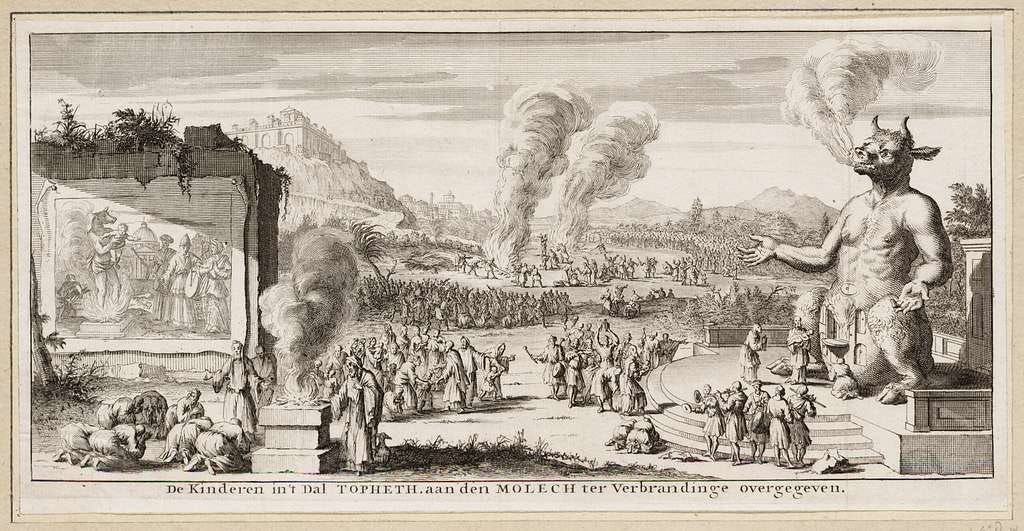
This essay traces the sacrificial pattern from bull to lamb to bread, but there is a layer beneath the bull that I have deliberately left out of this piece, because it deserves its own treatment. Before the bull, the most extreme offering was not an animal. It was a child. The Molech tradition, the Tophet at Carthage, the Valley of Hinnom, and the reason Abraham's hand was stayed on Mount Moriah: that is part is available only to paid subscribers and can be found here:

Coming next for free subscribers, a deep dive into the god Remphan.
"Yea, ye took up the tabernacle of Moloch, and the star of your god Remphan, figures which ye made to worship them."

When Stephen spoke those words before the Sanhedrin (Acts 7:43), he was quoting the prophet Amos and connecting two threads that most people treat as separate: blood sacrifice and star worship. Be sure to subscribe for more..
Bibliography
Anthony, David W. The Horse, the Wheel, and Language: How Bronze-Age Riders from the Eurasian Steppes Shaped the Modern World. Princeton University Press, 2007.
Bollongino, Ruth, et al. “Modern Taurine Cattle Descended from Small Number of Near-Eastern Founders.” Molecular Biology and Evolution 29, no. 9 (2012): 2101-2104.
Burkert, Walter. Homo Necans: The Anthropology of Ancient Greek Sacrificial Ritual and Myth. Translated by Peter Bing. University of California Press, 1983.
de Santillana, Giorgio, and Hertha von Dechend. Hamlet’s Mill: An Essay Investigating the Origins of Human Knowledge and Its Transmission Through Myth. Gambit, 1969.
Dever, William G. Did God Have a Wife? Archaeology and Folk Religion in Ancient Israel. Eerdmans, 2005.
George, Andrew, trans. The Epic of Gilgamesh. Penguin Classics, 2003.
Girard, René. Violence and the Sacred. Translated by Patrick Gregory. Johns Hopkins University Press, 1977.
Hodder, Ian. The Leopard’s Tale: Revealing the Mysteries of Çatalhöyük. Thames and Hudson, 2006.
Hubert, Henri, and Marcel Mauss. Sacrifice: Its Nature and Functions. Translated by W. D. Halls. University of Chicago Press, 1964.
Kilgour, Maggie. From Communion to Cannibalism: An Anatomy of Metaphors of Incorporation. Princeton University Press, 1990.
McClymond, Kathryn. Beyond Sacred Violence: A Comparative Study of Sacrifice. Johns Hopkins University Press, 2008.
Mellaart, James. Çatal Hüyük: A Neolithic Town in Anatolia. Thames and Hudson, 1967.
Schmidt, Klaus. Göbekli Tepe: A Stone Age Sanctuary in South-Eastern Anatolia. ex oriente, 2012.
Smith, Mark S. The Early History of God: Yahweh and the Other Deities in Ancient Israel. 2nd ed. Eerdmans, 2002.
Smith, William Robertson. Lectures on the Religion of the Semites. A. and C. Black, 1889.
Speidel, Michael P. Mithras-Orion: Greek Hero and Roman Army God. E. J. Brill, 1980.
Ulansey, David. The Origins of the Mithraic Mysteries: Cosmology and Salvation in the Ancient World. Oxford University Press, 1989.
Before I read this I will say that the practices of sacrifice/blood rituals and abuse are in no way/shape/form a loving act. Its my opinion that whatever convinced people to participate in these acts is not a fan of love.
"These substances, bread, wine, oil, share a defining characteristic: none of them exist in nature. God made the wheat, but humans made the bread. God made the grape, but humans made the wine. God made the olive, but humans made the oil."
Honey is not flowers. Bees take flowers and make honey. Yet are they not "Nature"? So are we a part of what is called "nature". The presupposition here is IMO slightly flawed because of the presumption that "human creative capacity" is not nature.