

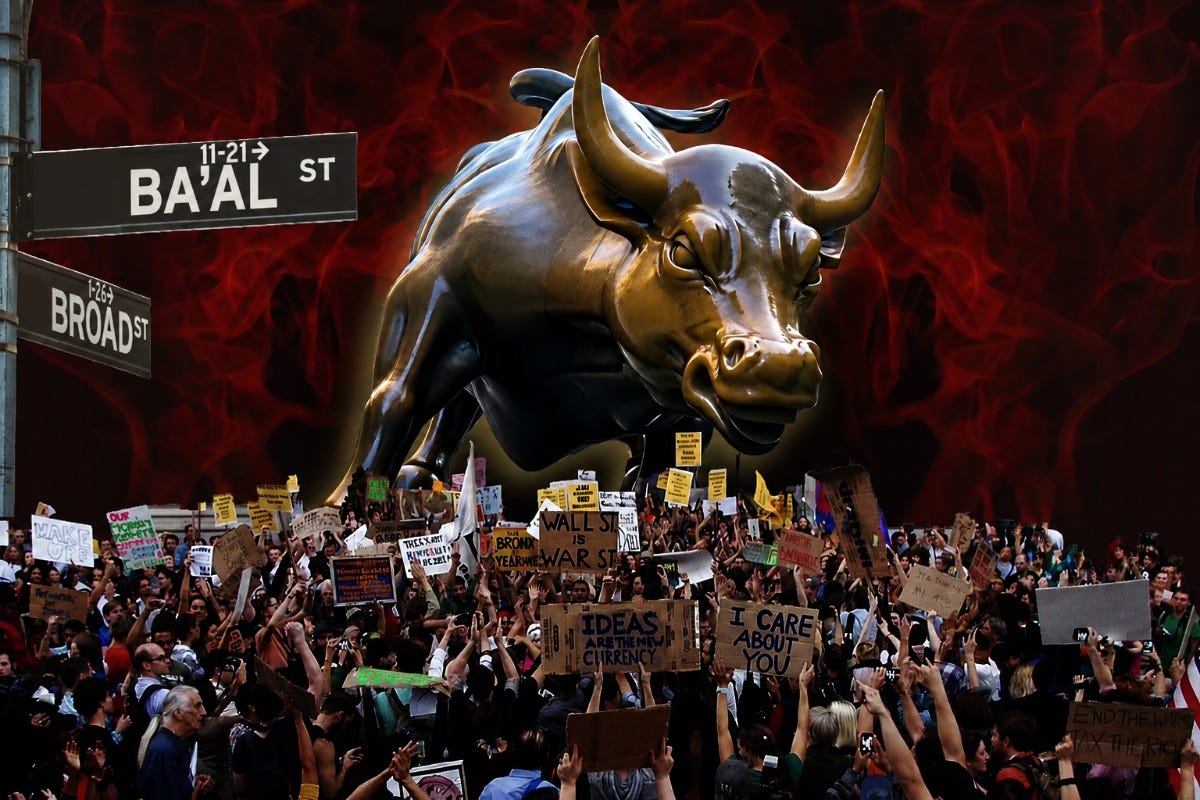
There is a bull at the gate of the American financial world.
It stands near Bowling Green in Lower Manhattan, all bronze muscle and lowered head. Tourists line up to touch it, as the faded patina on the monument’s scrotum attests. Traders read it as the mascot of market optimism. Critics see the idol of finance capital, a secular golden calf planted in the streets of the Financial District. The modern mind calls it public art, but the symbolic mind recognizes something much older.

Across the ancient Near East, the bull belonged to the visual grammar of sovereignty. It carried the force of storm gods, fertility gods, kingship gods, gods who claimed dominion over the earth. The Apis bull was the living vessel of Ptah at Memphis, the bull-calf of Yahweh appeared at Bethel and Dan in the divided kingdom, the Mithraic bull stood at Rome, the Cretan bull at Knossos, the bull-headed Asterion in the labyrinth, the bull-leaping rituals at Çatalhöyük seven thousand years before Rome. The bull is the oldest religious image still recognizable in the Mediterranean world. I traced this longer history in Ba’al, Blood, and Bread. Here the point is narrower.
Ba’al was a common noun before it was a name. The Semitic root baʿal meant lord, owner, master, possessor. It could attach to a god, a husband, a landholder, a ruler, or the commanding power of a place. The biblical writers who denounced Ba’al worship were denouncing a lordship that belonged to something other than the God of Israel, with the bull as its standing image. Every named Ba’al in the Levantine record (Ba’al Hadad, Ba’al Hammon, Ba’al-Berith, Ba’al-Zebub) was a particular instance of a more general idea: lordship over a place required a vessel to channel it.
The real question is not whether anyone on Wall Street is secretly burning incense to a Canaanite storm god (although it would not be a surprise these days). It is what modern people mean when they place a bull before the financial district and then insist that they no longer believe in lords.
Wall Street has lords. It also has temples, priests, offerings, ritual language, insiders who learn the grammar of the system and outsiders who live underneath its weight. It has names and seals and ledgers, markets, and corporations that exist as legal persons even though no human body can be found inside them.
The ancient world would have recognized this immediately. Modernity made a different assumption: when gods disappear from official theology, the structures that held them disappear too. They do not disappear, they just change costume. They show up in law, in finance, in psychology, in institutions, and even in brand logos.
One of them kept an office for several decades on the twenty-fourth floor of 120 Wall Street.
The Word
The group at that address calls itself Lucis Trust, founded in 1922 by Alice and Foster Bailey under the corporate name Lucifer Publishing Company. The name changed to Lucis Publishing Company in 1924 or 1925, depending on which of the Trust’s own sources you read. The justification was that the two names share a Latin root meaning light. I covered the founding and the United Nations footprint in the April 18 piece on the Great Invocation. That piece established what the group is and where it sits. This piece names what the older Western tradition called the thing it does.
The word is egregore.
The Greek root is egregoros, meaning wakeful or watcher. The word appears in the Book of Enoch, an Apocryphal Jewish text composed around 300 BCE, in the section called the Book of the Watchers. The angelic beings in that text are the egregoroi. They descended to earth, took human women as wives, fathered the giants called the Nephilim, and taught humanity the metallurgical, cosmetic, astrological, and ceremonial arts that the Genesis story places before the Flood. The word survives in modern English only as a technical term in Western esotericism, and it survives there because what the Watchers were said to do has been carried forward in different vocabulary ever since.
The cleanest modern definition comes from Joscelyn Godwin, a historian of esotericism at Colgate. An egregore is fed by human belief, ritual, and especially by sacrifice. If it is fed enough, it takes on a life of its own and starts to act like a personal god, with limited power on behalf of its worshippers and an unlimited hunger for more devotion. Its worshippers then experience it as a god, a saint, an angel, or in the modern world, a brand.
The Lucis Trust ecosystem uses the technical term. A 2017 French-language meditation document distributed through World Goodwill names large collective thought-forms as Egregores and warns that negative ones can turn back on their emitter. The English Lucis material prefers “group thoughtform,” but the technical referent is the same, and the source for both is the published writings of Alice Bailey.
What the Plan Actually Says
In 1939, six years before Alice Bailey received the Great Invocation, six years before the United Nations was founded, and fifty years before Lucis Trust acquired consultative status at the UN, an English Theosophist named Vera Stanley Alder published The Initiation of the World. Rider and Company brought it out in London. It went into multiple reprints, was reissued in 1969 and 1986, and stayed in print through the late twentieth century. Alder wrote in the voice of a devotee describing settled knowledge, not the voice of a seeker working things out.
After Blavatsky, in Alder’s words, “another gifted writer, Alice Bailey, was chosen to continue the message as first given out to the Theosophists.” The Master in question, Alder names: “Under the dictation of the Master of the Wisdom, Djwhal Khul, Alice Bailey wrote over a score of lengthy books.”
The twenty-four books are still in print through Lucis Publishing Company. The Trust calls them the foundation of what it calls the Ageless Wisdom.
Critics reading the published Bailey corpus identify the Plan as providing for the installation of a New World Teacher, named in different traditions as Maitreya, the Imam Mahdi, the Kalki Avatar, and the Bodhisattva, who would unify all religions under a single spiritual authority. The same critical readers identify provisions for a planetary religious order, the redistribution of resources, the disarmament of nations, and the elimination or sealing away of orthodox monotheism, treated by the doctrine as an obstacle to the planetary collectivism the writings envision. The Plan also describes mass planetary initiations, which the published writings call Luciferic initiations, and identifying symbols including the rainbow.
These provisions are enumerated by Bailey herself across the volumes Lucis Publishing Company prints. Alder’s 1939 summary, written from inside the movement in the devotee voice, confirms them. Critical readers of the corpus have been documenting them since the early 1980s.
Six years after Alder published her summary, in April 1945, Alice Bailey received the Great Invocation. Four months later the atomic bombs fell on Hiroshima and Nagasaki. Six months after that, the United Nations opened its doors. What came afterward was built to carry out what was already published teaching in 1939.
The Fabian at the Top
The teaching has a political family tree, running through the Theosophical Society, which was led for twenty-six years by a foundational figure in twentieth-century British socialism.
The Theosophical Society was founded in 1875 by Helena Blavatsky and Henry Olcott in New York City. After Olcott’s death in 1907, the international presidency passed to an English social reformer named Annie Besant, who held it until her death in 1933.
Before she ran the Theosophical Society, Besant was one of the original Fabian socialists. She co-authored Fabian Essays in Socialism in 1889 alongside George Bernard Shaw, Sidney Webb, and Beatrice Webb. That book is the founding text of British Fabianism, the gradualist socialist tradition that designed the British welfare state and has shaped the Labour Party for over a century. Besant was a co-author of the canonical text, not a peripheral signatory.
She moved next into Indian politics. She founded the Indian Home Rule League in 1916 and was elected president of the Indian National Congress in 1917. While she held both the Congress presidency and the international Theosophical presidency at once, she personally initiated a young Indian boy into the Theosophical Society. The boy’s name was Jawaharlal Nehru. He became the first Prime Minister of independent India. The state socialism he installed after independence, one of the largest non-Marxist socialist economies of the twentieth century, was modeled on Fabian lines. The Fabian Society’s own retrospective treats Besant’s socialism and her theosophy as continuous commitments.
Alice Bailey joined the Theosophical Society in 1917. She edited its American journal at the Krotona colony in California for three years and broke with Besant around 1920 over leadership and direction. She founded Lucis Trust in 1922 and the Arcane School in 1923. The break was over the running of the movement, not over the politics. The political-theological frame Bailey carried into Lucis Trust came directly out of the movement Besant led.
The metaphysics and the politics are one project: the dissolution of the individual into a managed universal collective.
In Bailey’s religious language, the individual soul is treated as fragmentary, the personal will as limited, discernment as glamour, resistance to the Plan as the personality-self obstructing the higher-self. Spiritual maturity becomes the surrender of separate identity into the universal consciousness of the Hierarchy. The technical language varies across the Bailey corpus, but the direction is consistent: the distinct self must be educated out of its separateness and absorbed into a greater whole.
The political doctrine follows the same logic at institutional scale. Nations are to disarm, resources are to be redistributed, religions are to be unified beneath a single World Teacher, economies are to be coordinated by a planetary authority, and the obstacle is always particularity: national sovereignty, orthodox religion, private property, individual conscience, local loyalty, inherited identity.
The same pattern repeats at every level. The little will dissolves into the Plan. The little nation dissolves into planetary government. The little religion dissolves into universal spiritual authority. The property-holding individual dissolves into the redistributed common stock. Each surrender is presented as progress, service, liberation, or enlightenment, while the universal structure receiving that surrender is administered by a hierarchy that claims to know what humanity cannot yet know for itself.
This is the control grid in its older religious vocabulary. Fabian gradualism supplied the patience; Theosophical-Bailey metaphysics supplied the sanctification. Together they produced a soft collectivism in which surrender could be made to feel voluntary, even noble. The individual gives up the self and calls it spiritual development. The nation gives up sovereignty and calls it peace. The believer gives up doctrine and calls it unity. The administrator receives the surrendered pieces and calls the arrangement service.
The same broad phenomenon was running in Russian Marxism at the same time. Alexander Bogdanov, Anatoly Lunacharsky, and Maxim Gorky developed what they called God-Building, an attempt to merge Marxism with millenarian religious language that Lenin had to attack directly in Materialism and Empirio-Criticism in 1909. The Anglo-American Theosophy-Fabian current and the Russian Marxist current were not in contact. They were the same broad intellectual phenomenon running in two countries, working out the same problem: how to get human beings to surrender their individual will to a collective administered by people they would never meet, and how to make the surrender feel like a spiritual achievement rather than a political defeat.
The “Little Wills” of Men
The Great Invocation is the central formula. I will not reproduce the whole text. The phrase that matters most is enough.
The prayer asks that the purpose which the Masters know and serve guide “the little wills of men.”
The little wills of men. Not the conscience of the individual. Not the sovereignty of the person. Not the discernment of the soul standing before God. The wills of human beings, called little, gathered into alignment with the Plan.
This is the prayer at the center of the operation that has been building toward planetary government since 1922.
Lucis Trust’s Triangles network is how the prayer gets distributed. Groups of three people link mentally each day, recite the Great Invocation, and picture light and goodwill flowing through a global network. The Triangles literature tells participants to become a “mental broadcasting unit” linking with the network of light and goodwill, charging the field of consciousness and mental environment with magnetic power. The doctrinal basis comes from Lucis Trust’s own Cycle of Conferences material, which says coordinated visualization builds:
a large and potent group thoughtform... capable of externalizing on etheric levels and performing work.
The practice gets applied to specific international events. The 2023 COP28 climate conference meditation focus directed participants toward the “mental atmosphere” of conference attendees and the “thoughtform under construction” at the conference, telling them to project “seeds of living will energy” into it. The 2025 United Nations High-Level Political Forum was framed under the heading “Holding the Sustainable Development Thoughtform in the Group Gaze.” Year after year, the same method, applied to whichever international body is meeting next.
The source is Alice Bailey’s own Treatise on White Magic. In her own definition, “true occult work” is contacting the Plan, cooperating with it, and building and directing thought-forms from the mental plane. A thought-form, once built, is not merely an idea. It has, in her language, a life cycle of its own. It may manifest. It may perform work. It may move beyond the imagination of the person or group that generated it.
Bailey also warned about what can happen when the work runs unchecked. A thoughtform may stay in the creator’s aura, or it may find its way to another person or group. The creator may become victim to the thing built. The thoughtform can become stronger than its creator.
The founder of the movement warned that the thing they built could exceed them. Lucis Trust is still building.
That is ritual engineering.
Wall Street to United Nations Plaza
Lucis Trust has not always used the address it uses now. The current contact points to United Nations Plaza. Older Lucis materials list 120 Wall Street, twenty-fourth floor, for offices and meetings. The Wall Street address was a symbolic match: an occult nonprofit housed inside the financial district, in the same city blocks as the corporate form, the market idol, and the dream of planetary government.
The move from 120 Wall Street to United Nations Plaza is the argument in miniature. Finance disciplines behavior through debt, scarcity, ambition, and reward. Planetary government disciplines behavior through policy, moral language, crisis management, and the promise of coordinated salvation. Between them stands the spiritual operator, teaching that human will must be educated, aligned, and pointed in service of a Plan.
The address moved from market lordship to planetary government. The work did not change. The geography updated to match what the group had already accomplished. The Wall Street phase was the construction. The UN phase is the scale.
The next coordinated global recitation of the Great Invocation falls on Sunday, May 31, eight days from when this piece publishes. Lucis Trust calls it World Invocation Day. Participants are told to recite the prayer at sunrise, noon, 5:00 p.m., sunset, and the exact time of the full moon, to “add rhythmic potency to the work.”
The Corporate Form
The corporation is the modern egregore, and almost nobody recognizes the equivalence because the corporation hides behind legal language while the egregore hides behind occult language. Strip both vocabularies away and the same thing is doing the same work.
An egregore, in the older definition, is a non-physical entity created by collective human attention, fed by ritual and belief, named with a specific name, represented by a symbol, served by a hierarchy of devotees, and eventually capable of acting on those devotees in ways they cannot fully resist. Now consider McDonald’s. It has a name. It has a symbol (the golden arches, which can be recognized by more children worldwide than the Christian cross). It has rituals (the daily transaction, the predictable menu, the standardized environment). It has a hierarchy of devotees who serve it (workers in uniforms reciting scripted greetings). It has worshippers who feed it (customers, billions of them, every day). It has, in its own legal documents, a personality. It can own property. It can sue and be sued. It can outlive every human being who has ever worked for it. It cannot be killed by the death of any individual, only by the withdrawal of collective attention and feeding. It acts back on the people inside it, shaping their behavior, their language, their bodies. By every operative criterion in the egregore definition, McDonald’s is an egregore. The only thing missing is the language that would call it one.
The legal history of how the corporation acquired this status is straightforward. Persona ficta is Latin for fictitious person. The phrase comes out of medieval canon law, developed by Pope Innocent IV in the thirteenth century to give corporate bodies, mostly monasteries and ecclesiastical communities at the time, a legal standing that let them hold property, sign contracts, and act in the world as if they were natural persons. The corporation as a legal entity is older than the United States by five hundred years. The medieval Church created it to give institutions a soul they did not earn by being born.
