

Jeffrey Epstein and the God Who Eats Children
How child sacrifice moved from sacred fire to sealed files, elite networks, and the attention economy.

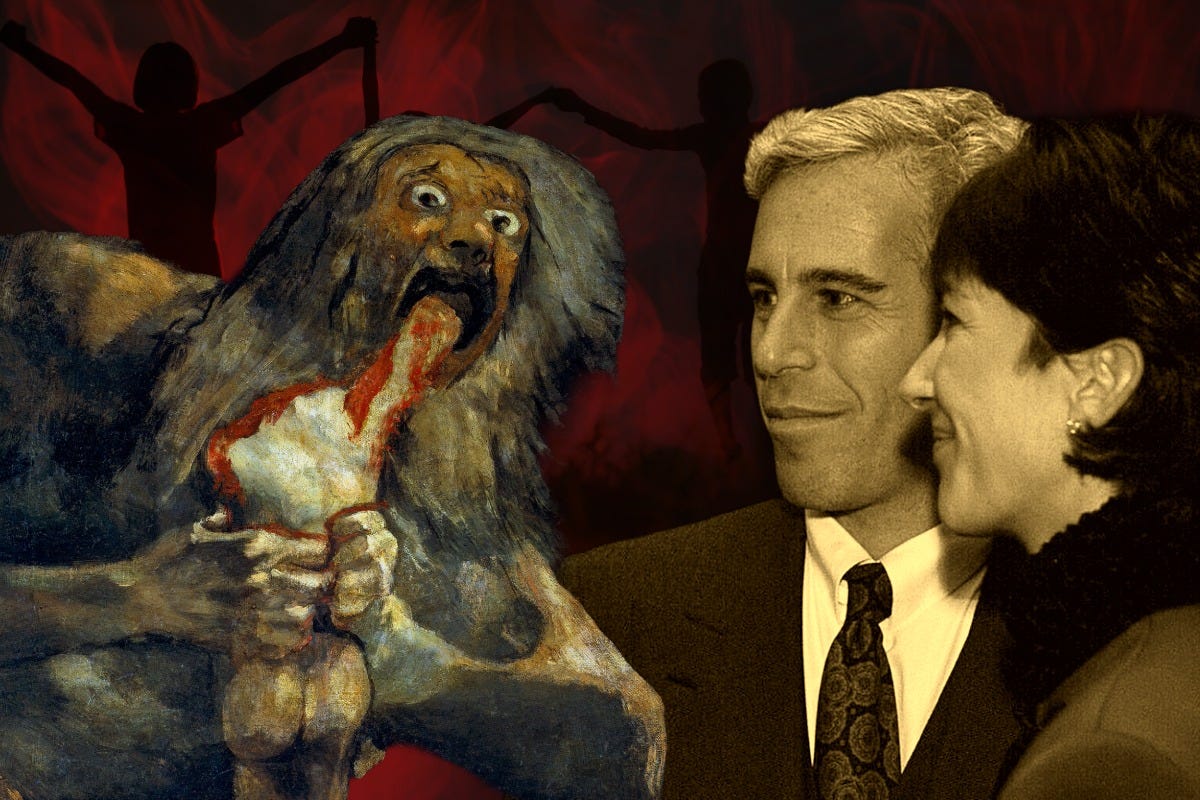
This is a merger and expansion of a previous article.
In 1980, Pat Benatar released a song called “Hell Is for Children.” It was about child abuse. She could not have known how literally accurate the title was.
The word translated as “hell” in the New Testament is Gehenna, the Greek rendering of Ge-Hinnom, the Valley of Hinnom, a ravine along the southern edge of Jerusalem. That valley became synonymous with damnation because it was remembered as the place where children were burned as offerings.
Hell is named after the geography of child sacrifice.
We built our worst image of the afterlife out of something human beings had already done to their own young. Long before hell was a doctrine, a sermon, or a threat about the next world, it was a ravine south of Jerusalem and a memory of what happened there.
This is an old subject with a live docket. Since the Epstein Files Transparency Act became law in November 2025, the Department of Justice has published nearly 3.5 million pages of investigative material on Jeffrey Epstein’s trafficking network, and the resignations are still being counted as those pages are read. Keep that in view as we descend. The road out of the Valley of Hinnom runs closer to the present than most people are prepared to believe.
The history of sacrifice is often told as a story of religious progress: the raw offering becomes refined, the slaughtered animal becomes symbolic food, blood becomes wine, flesh becomes bread, and the altar grows less visibly violent with each theological transformation. There is truth in that telling. Beneath it, however, sits a darker question. What was being replaced? What stood at the beginning of the chain, before the bull and the ram and the lamb, before bread and wine?
The oldest and most terrible answer is the child.
Is Molech a God?
The first obstacle anyone encounters when studying this subject is that scholars cannot agree on what the word Molech even means.
The older and more popular understanding, stretching back through rabbinic commentary and classical sources like Diodorus Siculus, treats Molech as a distinct deity: a Canaanite or Ammonite god to whom children were offered by being “passed through the fire.” The Hebrew Bible gives us Molek. Leviticus 18:21 forbids giving one’s seed to Molech. Leviticus 20:2–5 prescribes death by stoning for the offense. Jeremiah 32:35 names the Valley of Ben-Hinnom as the place where Judahites built the high places of Ba’al “to burn their sons and their daughters in the fire to Molech.”
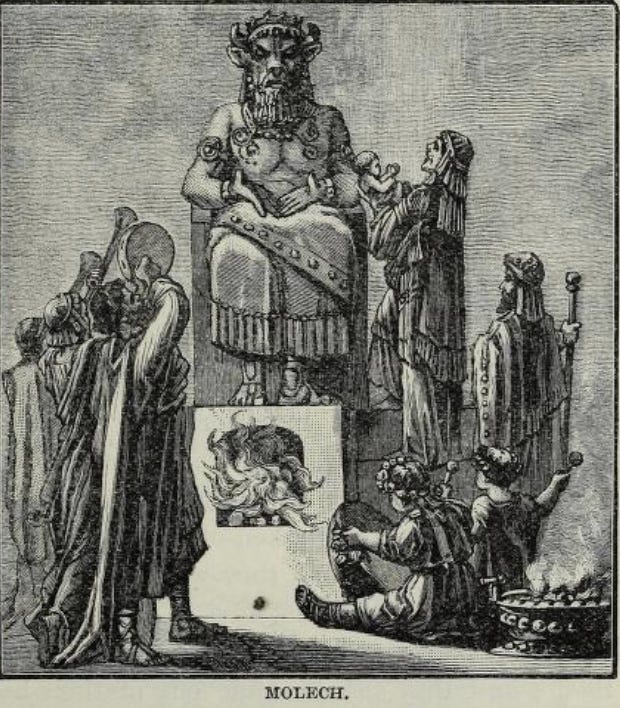
The rabbinic image of Moloch is almost too horrifying to forget: a great bronze figure, seated on a throne, with the body of a man and the head of a calf. Its hollow belly was a furnace. Its arms were arranged so that the victim placed upon them would roll toward the fire. Tradition says the cries of the children were masked by drums. That image is late and polemical, yet it endured because it gave form to the accusation. It made the essential horror visible: a god with a furnace in his body, a ritual machine for turning children into smoke.
Beginning in the twentieth century, scholars including George C. Heider and John Day sharpened a different argument. On this reading, Molech may not originally have been the name of a god at all. The consonantal root m-l-k is related to melek, meaning “king,” yet the vowels in the Masoretic text appear to echo boshet, “shame.” Hebrew scribes sometimes used the vowels of “shame” to deface the names of rival gods. Strip away that polemical vocalization and one may be left with molk or mulk, a term that appears in Punic inscriptions from Carthage as a technical term for a type of votive offering rather than a divine name. Punic texts distinguish, for example, between a molk-offering of a lamb and a molk-offering of a human being.
That difference matters. If Molech is a god, the biblical writers are condemning the worship of a particular deity. If molk is a kind of sacrifice, the accusation becomes broader and in some ways more disturbing. “Passing children to Molech” may mean performing a molk-sacrifice, perhaps to Ba’al, perhaps to El, perhaps to a divine recipient whose identity shifted by place and period.
This is why Ezekiel 20:25–26 is so unsettling. The prophet has God say, “I also gave them statutes that were not good and ordinances by which they could not live. I defiled them through their very gifts, in their offering up all their firstborn.” Francesca Stavrakopoulou has argued that such passages preserve a disturbing memory: that firstborn sacrifice may once have been understood by some Israelites as something connected to YHWH himself, before later biblical theology violently rejected it.
Whether Molech is a name or molk is a ritual type, the underlying scandal remains. Children were offered, fire was the medium, and the practice was tied to Ba’al worship in ways the biblical writers found abominable yet could not pretend did not exist.
The Tophet
A Tophet is a sacred open-air precinct, typically outside the walls of a city, where offerings were burned and cremated remains were buried in ceramic urns beneath stone markers. The term is most often associated with Phoenician and Punic sites across the western Mediterranean: Carthage, Motya, Tharros, Sulcis, and others. The word itself has often been connected with the Hebrew toph, “drum,” because later tradition imagined drums beating to drown out the cries of the offering.
In the biblical text, the Tophet sits in the Valley of Ben-Hinnom, just south of Jerusalem. This is the same valley where we began: Ge-Hinnom, Gehenna, hell. King Josiah’s reforms specifically targeted the site, defiling it so it could no longer be used. That detail matters. You do not defile a place because someone once had a bad idea there. You defile it to stop a practice.
The most famous archaeological Tophet is at Carthage, in use from roughly the eighth through the second century BCE. Thousands of ceramic urns have been found there containing the cremated remains of infants and very young children, sometimes mingled with animal remains. Dedicatory stelae invoke Ba’al Hammon and Tanit.
The classical sources are blunt. Diodorus Siculus describes a bronze statue of Kronos with outstretched arms, onto which children were placed so they could roll into the fire. During the siege of Carthage in 310 BCE, he claims that two hundred children of noble birth were sacrificed to restore divine favor.
Modern scholars have fought over this evidence for decades. Jeffrey Schwartz and his colleagues, the leading revisionists, have argued that the age-at-death profiles of the Carthage remains could be consistent with natural perinatal mortality, that the Tophet may have served as a burial ground for the very young regardless of how they died, and that the Greek and Roman sacrifice stories may carry the stain of anti-Carthaginian propaganda. On the other side, Lawrence Stager, Patricia Smith, Paolo Xella, and Josephine Crawley Quinn have argued that the age distribution, the ritual setting, the cremation pattern, and the dedicatory inscriptions, which record vows fulfilled to the gods, make it very difficult to reduce the Tophet to an ordinary cemetery.
I am not going to pretend to resolve that debate. The honest position is to hold the tension. The Tophet may have contained children who died naturally. It may also have contained children deliberately offered. Ancient ritual life does not always divide neatly into categories that modern people prefer.
What stands beyond dispute is that Ba’al Hammon presides over the Carthaginian site, and that the remains of infants were placed in a ritual field dedicated to divine powers.
Not Yet a Person
There is another anthropological problem here, and it bears directly on the horror. At what point does a child become a person?
In many traditional societies, the answer was more complicated than “at birth.” In ancient Rome, a newborn was not formally incorporated into the family until the dies lustricus, the purification day, usually on the eighth or ninth day. Before the rite, the child had not yet fully crossed into legal and social personhood. Greek exposure practices ran on a similar logic: what has not been named, accepted, and ritually received by the household exists in a dangerous border zone.
The age profile of many Tophet remains falls close to that threshold. Far from softening the horror, that proximity deepens it, because it shows how easily societies can arrange their metaphysics to make the vulnerable disposable. A being not yet fully named, not yet ritually incorporated, not yet socially recognized, can be treated as returnable.
The prophets of Israel were fighting exactly this logic. When Ezekiel has God call the sacrificed children “my children,” the possessive is radical. In that single word, the children cease to be pre-persons or ritual property. They are already claimed by God. The prophetic assertion of the child’s sacred status from the very beginning is one of the great moral revolutions of biblical religion, and we have inherited it so deeply that we forget it had to be fought for.
The Prophets Knew
The biblical response to child sacrifice is sustained, furious, and local. Nothing about it reads like a stray condemnation of something safely foreign.
Jeremiah says the people built the high places of the Tophet in the Valley of Ben-Hinnom “to burn their sons and their daughters in the fire,” something God says he did not command and that did not come into his mind. Ezekiel makes the accusation even more intimate: “You took your sons and your daughters, whom you had borne to me, and these you sacrificed to them to be devoured.” Psalm 106 remembers the same horror: “They sacrificed their sons and their daughters to the demons; they poured out innocent blood.”
The prophets were describing something that had entered their own land, their own city, their own ritual imagination. You do not spend that much prophetic energy condemning a practice that nobody is practicing.
The reform eventually won. It won, however, against a real opponent rather than a fantasy.
That opponent was never confined to the Levant. Human sacrifice recurs in many civilizations, and child victims appear wherever divine hunger, political power, and the expendability of the young converge. When Cortés entered the temple precincts of Tenochtitlan, Spanish sources describe walls stained with blood and ritual spaces saturated with the smell of death. Aztec sacrifice did not spare children. In the Andes, Inca capacocha placed children on mountaintops as offerings, some preserved in ice with devastating clarity. Shang oracle bone inscriptions record the sacrifice of captives and, in some cases, children, to royal ancestors.
Child sacrifice is a human problem rather than the property of one people, one religion, or one ancient cruelty. It appears wherever a society convinces itself that the future can be spent to secure the present.
Saturn Devours His Children
The Greek and Roman mythological traditions preserve the same pattern in another language. Kronos, Saturn to the Romans, devours each of his children at birth because he has been told that one of them will overthrow him. Only Zeus escapes. Rhea hides the infant and gives Kronos a stone wrapped in swaddling cloth. The father consumes the substitute, and the child survives.
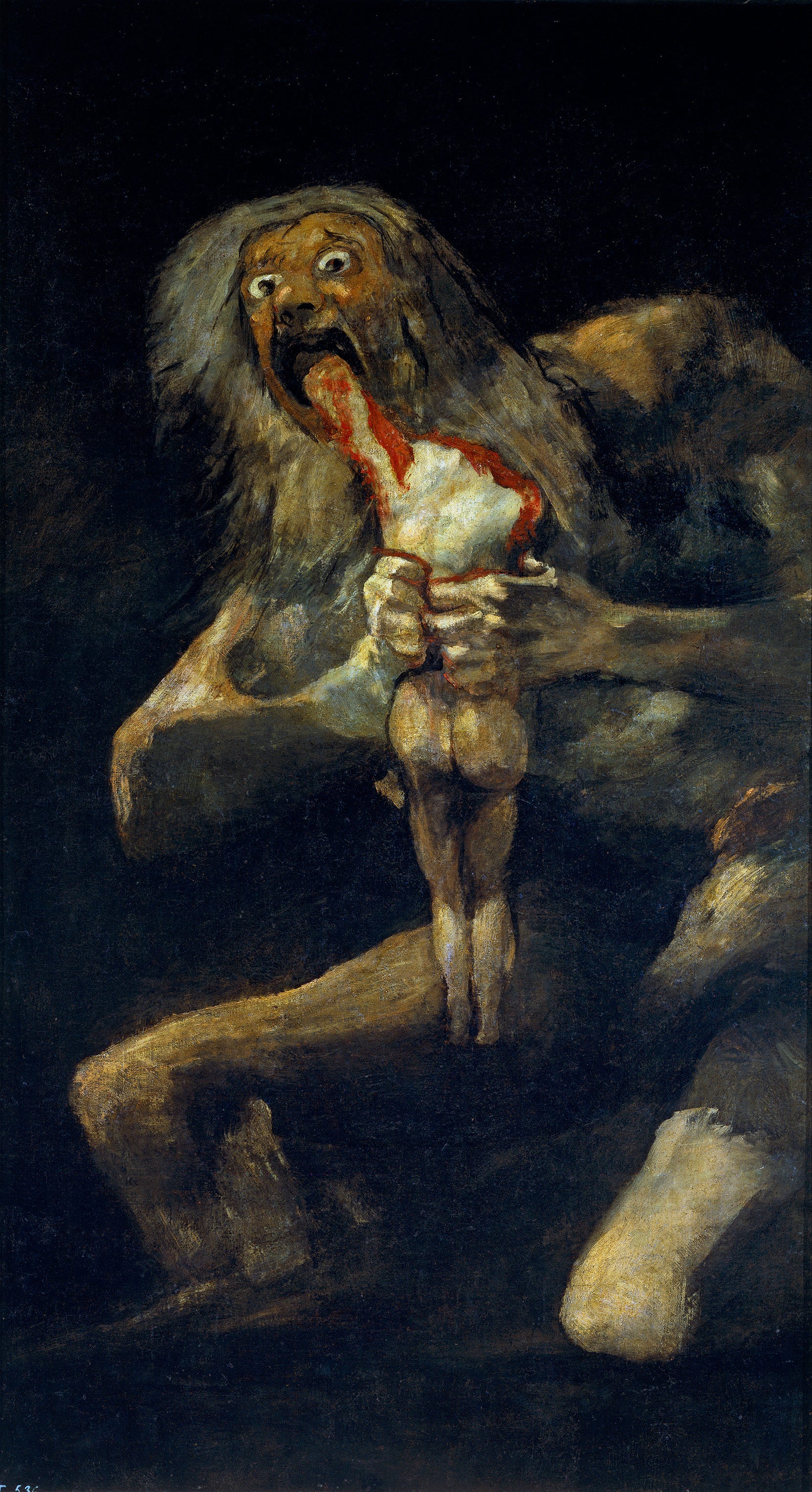
The logic is unmistakable: the old power eats the young to prevent succession, and the cycle is broken only by substitution.
That myth sits near the center of Western civilization. The father-god with his children inside him, time itself consuming its offspring, the ruler swallowing the future before it can replace him.
The Greeks identified Kronos with the Phoenician Ba’al Hammon, and the comparison was anything but random. In the Phoenician material preserved by Philo of Byblos, El or Kronos is said to have sacrificed his own son during crisis. Across the Mediterranean, the figure of the old god, the king, the father, the devourer, and the receiver of child sacrifice begins to overlap.
The alchemical tradition carried the image further. In material attributed to Nicolas Flamel, an image identified with Herod and the Massacre of the Innocents is read through the figure of Saturn devouring his children. The mythological and biblical layers collapse into one another: the child destroyed, the matter dissolved, the old form burned away so something else can be made.
Alchemy often speaks in the language of transformation. The prima materia must be broken down, blackened, dissolved, burned, and reconstituted. That symbolic process can be read spiritually or psychologically. When the image of the child appears inside that furnace, though, the symbolism becomes harder to contain. The question returns: what kind of power imagines transformation through the destruction of the young?
In the myth of Demeter and Demophon, the goddess attempts to make an infant immortal by placing him in the fire each night, burning away mortality. Here the fire does not destroy the child, at least not in the goddess’s intention. It purifies, transfigures, and prepares him for another order of being. The mother interrupts the rite, horrified, and the boundary is reasserted. The child cannot be handed over to divine fire without human protest.
That protest is the beginning of civilization.
Every later system of sacrifice is, in some sense, an answer to the same question: how do we stop Saturn from eating his children?
What the Fairy Tales Remember
The official theological traditions claim they ended child sacrifice. The fairy tales are not so sure.
Remember Hansel and Gretel? Children are abandoned by parents who cannot feed them. They are lured by a house made of food. A witch cages them, fattens them, and prepares to cook them in an oven. The children survive by pushing the witch into her own furnace. When they return home, the mother is dead, which has led many readers to notice the doubling between mother and witch. The parent who sacrifices the children and the monster who cooks them may be two faces of the same figure.
The elements are ancient: hunger, debt, abandonment, a furnace, a monstrous feminine figure, and children nearly consumed so adults can survive.
In Rumpelstiltskin, the state demands an impossible payment. Straw must become gold. The young woman cannot satisfy the demand, so a strange little being performs the impossible work in exchange for her firstborn child. The debt moves downward. The child is collateral for the adult bargain.
The figure recurs far beyond the Brothers Grimm. Baba Yaga threatens to eat children who enter her domain. The Japanese yamauba devours travelers and the young. In Balinese tradition, Rangda appears as a terrifying child-eating witch whose ritual combat with Barong is performed as a communal drama of protection and disorder. The child-eating figure appears everywhere, wearing local costume while performing the same work. She preserves the memory of a danger official culture wants to outgrow.
The hagiography of Saint Nicholas gives us the Christianized version. Three boys are murdered by a butcher, dismembered, and stored in brine. Nicholas discovers the crime and restores them to life. Later, Nicholas becomes the gift-giver of children, the one who watches behavior, rewards obedience, and travels from the world axis with a dark punishing double: Krampus, Père Fouettard, Zwarte Piet, and other figures who threaten to beat, kidnap, or carry away the disobedient young.
Nicholas is both the rescuer of children from being eaten and the figure whose mythic world still circles the threat that children can be taken, punished, or consumed. He is Saturn restrained by sanctity, the old devourer baptized into the saint who saves.
Fairy tales remember what doctrine claims to have ended. The oven has not gone cold, the little man still comes to collect, and the butcher still keeps barrels in the back room.
The Hand That Was Stayed
The Binding of Isaac, the Aqedah, is the theological hinge of the entire problem.
Abraham is commanded to sacrifice Isaac on Mount Moriah. He obeys, builds the altar, arranges the wood, binds his son, and raises the knife. At the last moment, an angel intervenes. Abraham sees a ram caught in a thicket and offers it in his son’s place.
The story answers the question: why do we sacrifice rams rather than children?
Because the hand was stayed.
The ram replaces the son. The child is spared. The substitution is authorized by God himself, and a new sacrificial order begins. Whatever else the story means, it marks a boundary. The god of Abraham is not to be fed by the body of Isaac.
The mountain matters. Moriah becomes associated with the Temple Mount, the place where animal sacrifice will later be centralized. The site where the child was not killed becomes the place where lambs and rams die in his stead. The altar remains. The victim changes.
This is the echo that reverberates through the New Testament when John the Baptist says of Jesus, “Behold, the Lamb of God, who takes away the sin of the world.” The lamb that replaced the child on Moriah is itself replaced by the divine son who willingly goes to the altar. In Christian theology, the cycle of substitution reaches its final term at the Crucifixion: one death to end all deaths, one son to end the sacrifice of sons.
That is the official theological answer, but as discussed in Ba'al, Blood, and Bread: The Oldest Pattern in Religion, history is more than theology. The hand may have been stayed in scripture, yet the old hunger did not disappear from the human imagination. It went underground. It survived in images, accusations, fairy tales, political systems, hidden crimes, and the recurring conviction that someone’s child must pay for someone else’s power.
What the Gods Eat
The Neoplatonist philosopher Porphyry made an argument in the third century that changes the way this entire history can be read. In On Abstinence from Killing Animals, he argued that the highest gods do not need blood, smoke, flesh, or the terror of the dying. Blood sacrifice, he said, attracts a lower class of beings: daimones, sub-divine entities that inhabit the lower spiritual order and feed on the offerings humans mistakenly believe they are giving to the gods.
Porphyry’s argument is devastating because it reverses the direction of suspicion. The beings demanding blood may not be divine at all. They may be parasites wearing divine masks.
In contemporary esoteric language, this comes very close to the concept of the egregore: a collective psychic entity sustained by the directed attention, emotion, ritual behavior, and belief of human communities. Nations and corporations qualify. So, under certain conditions, do gods.
Porphyry did not use that word. He spoke of daimones. The shape of the claim is the same, though. Certain powers feed on human attention and offering. The more intense the offering, the stronger the feeding. There is no offering more intense than a child.
If Porphyry was right, the prophets were fighting over more than morality. They were fighting over who, or what, gets fed. The Ba’alim, the Molech tradition, the Tophet: these represent an arrangement in which human communities are locked into a feeding relationship with powers that grow more demanding over time.
The Yahwist reformers claimed to end that cycle. The Christian theologians claimed to complete the substitution. The question remains, though: what happens to a hungry power when the temples close?
Does it starve?
Or does it perhaps learn to eat somewhere else?
The Oven Still Burns
The darkest layer of the sacrificial tradition sits beneath the bull, beneath the ram, beneath the lamb, beneath the bread and wine. Each replacement moves away from the most extreme form of offering. The prophets believed they ended it. The theologians codified the substitution. The official story says the child was spared.
Old forms, though, do not vanish simply because new ones replace them. They persist in myth, geography, alchemy, ritual accusation, folk memory, and cultural repetition. The oven in Hansel and Gretel has never been allowed to cool, and the little man is still waiting to collect the firstborn when the debt comes due.
We flatter ourselves by thinking these horrors belong to a superstitious past, or to some faraway culture, or to the villains of fairy tales. The arrangement continues, however, wherever the young are made to pay for the bargains of the old.
Consider Jeffrey Epstein. He ran a network rather than a temple, yet the function was older than either. Children and young girls were procured, trafficked, passed upward, and used as currency among powerful men. Nothing about the operation was religious in any conventional sense. It was sacrificial in the older anthropological sense: vulnerable bodies were offered into a system that created power, leverage, silence, and mutual implication, a system whose paper trail the Department of Justice has now been forced to publish, nearly 3.5 million pages of it.
In Gaza, children die inside a war whose language is steeped in ancestral claim, sacred land, prophetic rhetoric, and existential necessity. The word “collateral” cannot contain what has happened to the young there. Entire families have been erased. Schools, hospitals, and refugee camps have been struck. Whatever one believes about the political arguments, the children did not choose the history into which they were born, yet they are paying for it with their bodies.
This is how sacrifice survives in modern language. We no longer call it molk. We call it national security, the cost of war, intelligence failure, proportionality, deterrence, regrettable loss, market discipline, institutional protection, or the price of doing business.
A vocabulary that can make the death of children sound procedural is already halfway back to the altar.
Below this line, the essay leaves the ancient record and enters the modern one: the men who invoke the old names on purpose, the burning rite performed each summer by some of the most powerful men in America, the Epstein network read as a sacrificial economy, and the uncomfortable evidence that panic itself can be a form of worship. The H Files takes no sponsors and answers to no institution. This work exists because paid subscribers fund it. If it matters to you, subscribe.
