



The simplest (not easiest) spiritual practice in the world has been turned into a punchline.
Just Say No was a 1980s anti-drug campaign, and the slogan became a national joke for being shallow, simplistic, and ineffective at addressing addiction. The criticism was fair. You cannot stop addiction with a slogan.
The opposite tagline ran the same decade. Just Do It, Nike’s 1988 campaign, became the most successful advertising line of the late twentieth century. The agency that wrote it, Wieden+Kennedy, has admitted in interviews that the phrase was adapted from the last words of Gary Gilmore before his execution by firing squad in 1977. Gilmore told the executioners let’s do it. The tagline that shaped a generation of consumer culture was inspired by a man’s invitation to his own death.
The two slogans were symmetrical opposites. Just Do It told you to act, to perform, to consume, to move, while Just Say No told you to refuse. Both were marketing campaigns, but only one survived. That is because the patron prefers the slogan that produces motion. Action generates revenue for the corporation. Refusal does not.
The practice of refusal is ancient and visible in just about every contemplative tradition. Stoic philosophy, the Sermon on the Mount, the Egyptian desert monastics, Taoist sages writing in China, all arrived at the same conclusion separately and over millennia.
The ability to say no is what makes a self possible. Without it, you are not a person. You are a surface that things happen on.
Tuesday’s H Files piece on humiliation ritual ended on the directive take it back. Tuesday named what was happening. This piece gives insight into the discipline that lets you walk away from it.
What Hygieia Was
I took this photograph at the Museum of Fine Arts in Boston the last time I was there. A second-century Roman marble of the Greek goddess Hygieia, daughter of Asclepius, holding a shallow offering dish and feeding the serpent that wraps around her arm. Her name is where we get the English word hygiene, but the modern usage has narrowed considerably.
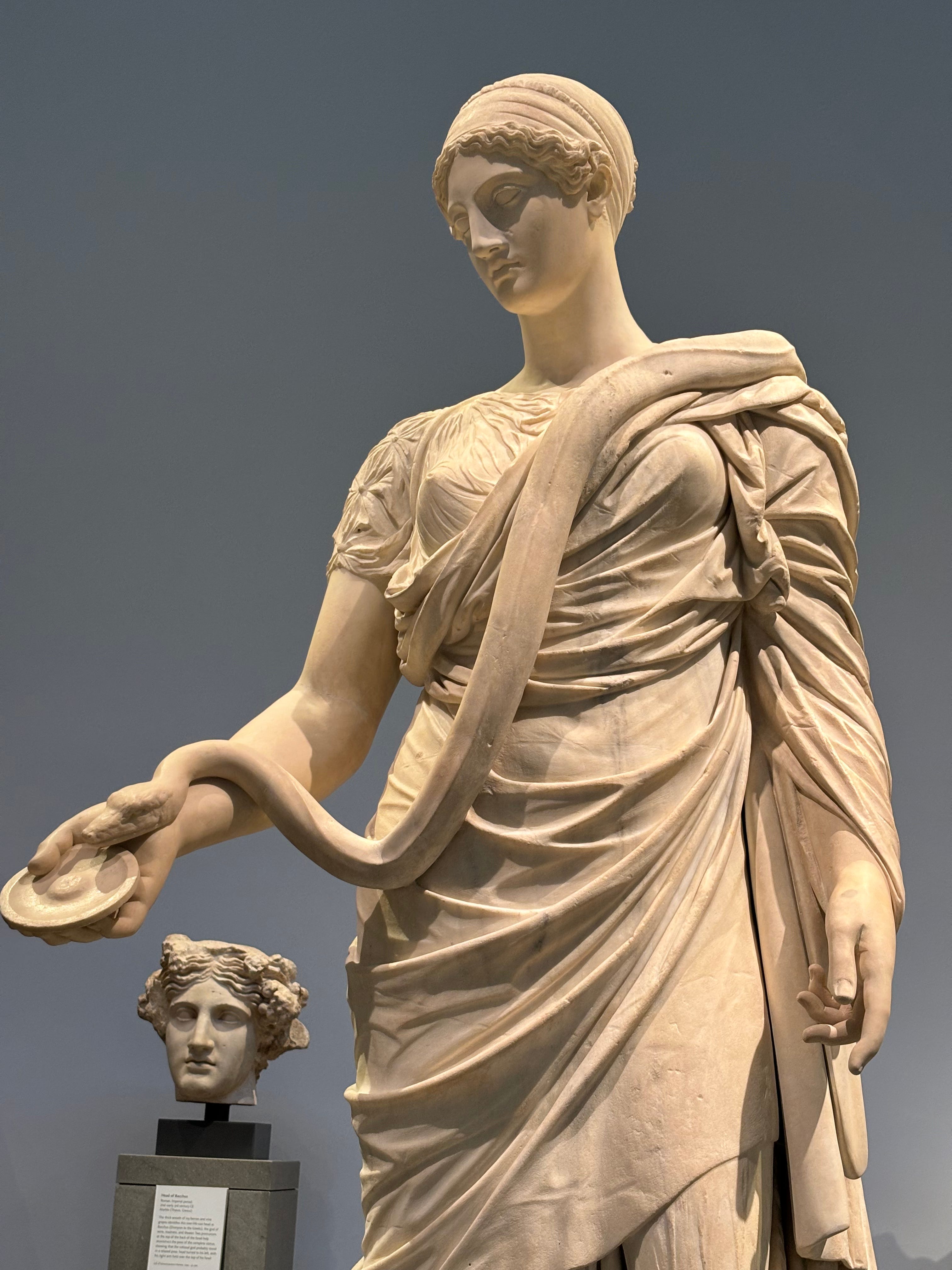
To the Greeks, hygieia meant more than just washing your hands. It was the preservative discipline of the body and the soul together. The steady practice of attending to what you let in. What you ate, what you drank, what you looked at, what you listened to, what you allowed near you. The serpent was sacred to her father Asclepius and his healing cult, and she fed it deliberately. The work was not avoidance. It was conscious participation. She decided what the serpent received.
Hygieia is refusal in embodied form. She is what it looks like to be the one deciding what enters and what does not. The principle she carries is older than any contemplative tradition that wrote it down.
What did the philosophers do with the same insight a few centuries later? They built a school around it, of course.
Epictetus and the Faculty of Choice
Epictetus is the right Stoic to start with. He was born a slave in Phrygia around 50 CE, was eventually freed, and taught philosophy in Rome until the emperor Domitian banished philosophers from the city. He spent the rest of his life teaching in Greece. His Discourses opens with a sentence that has done more work than any other line in the Western contemplative tradition.
Some things are up to us, and some are not.
What is up to you, in Epictetus’s accounting, is one thing only. Your prohairesis. The Greek word translates roughly as the faculty of choice, but the better translation might be the will, in the older sense of the word. The faculty by which you assent to or refuse what is presented to you. Everything outside that faculty, your body, your reputation, your wealth, your circumstances, the opinions of others, is not up to you. The only thing fully yours is the choice you make about what to accept and what to refuse.
Epictetus put it more sharply elsewhere. You may chain my leg, but my prohairesis not even Zeus himself can overcome (Discourses 1.1.23).
The world will keep arriving with offers and demands and threats dressed as enticements. The faculty of refusal is what determines whether you are a person inside that flood or a leaf moved by it.
Let Your Yes Be Yes
Jesus answered the question in eleven words.
The Sermon on the Mount compresses the same teaching into a single line:
Let your yes be yes and your no be no (Matthew 5:37).
It’s easy to gloss over this verse because it sits between bigger statements. It does not feel as dramatic as the Beatitudes or as challenging as love your enemies. Nevertheless, Jesus is saying that the integrity of your yes and no is the foundation of everything else. The person whose yes and no can be trusted is a self. The person who hedges everything is not. The verse continues, anything more than this comes from the evil one. The mode of speech where everything is qualified and conditional and footnoted, where you cannot tell whether someone has said yes or no, is named here as a spiritual problem. In other words, be decisive, because the devil owns the fence.
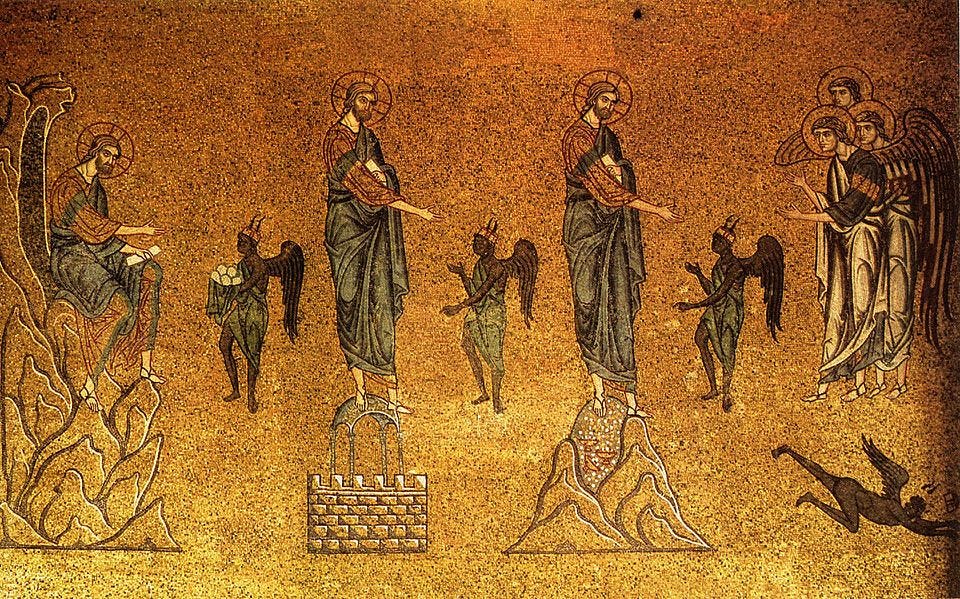
Jesus also showed what refusal looks like in practice. The wilderness temptation in Matthew 4 is three offers. Bread to break the fast, political power, and a public miracle to prove who he was. He refused each one. The contemplative traditions were already teaching what the wilderness story dramatizes. The patron offers what looks like good, and the work is refusing it anyway.
Stillness and the Empty Cup
The same insight arrived in different vocabularies, separated by centuries and a continent.
The fourth century Egyptian Christian hermits known as the “Desert Fathers” built an entire monastic tradition on the discipline of refusal. They called it apatheia, sometimes translated as apathy but meaning something closer to freedom from being moved against your will. The state of being untroubled by what you have not chosen.
A saying from Abba Macarius (Apophthegmata Patrum, Macarius 23) gets at this. A young monk asked him for a word of guidance. Macarius told him to go to the cemetery and abuse the dead. The monk did. He insulted them, mocked them, threw stones, and came back. Macarius asked what the dead said. The monk said they said nothing. Now go praise them, Macarius told him. The monk went back and called the dead holy, beautiful, righteous. Same answer. The dead said nothing. Until you are like that, Macarius told him, neither moved by insult nor by praise, you have not learned anything.
Half a world away and centuries earlier, Lao Tzu was teaching the same insight in a different idiom. The Tao Te Ching, chapter eleven, takes three concrete examples. The wheel works because of the empty hub at the center. The pot holds water because of the empty space inside it. The room is useful because of the empty space the walls enclose.
We work with being. The usefulness comes from non-being.
Refusal is the practice of maintaining that empty space. The full schedule cannot accept the next thing. The full life cannot receive what is meant for it. Saying no is what keeps the cup ready to be poured into. The old saying tells you that you cannot pour from an empty vessel. The older teaching tells you that you cannot receive into a full one either. Both are true. The discipline is keeping the cup at the level where it can both give and receive. It’s about balance, as these things often are.
So why is the practice so hard, if it has been articulated for thousands of years?
What the Conditioning Gets in the Way
The conditioning runs deep. I have been practicing this discipline hard this week. Saying no to opportunities a lot of people would consider exciting. Television appearances, travel I would have loved, projects that would have been fun. Refusal is harder when the offer is good. Anyone can turn down what they do not want.
I notice three particular conditioning patterns making the practice harder than it should be.
The first is the socialization to be nice. Most people are trained from childhood that saying no is rude. Women especially. We often feel we should soften every refusal with apology, that the relationship matters more than our actual answer. The training is so deep that even those who recognize it intellectually still feel the discomfort of it physically when they say no. The body interprets refusal as social danger. Cortisol rises. The brain offers fifteen reasons to say yes after all.
The second is the Appalachian conditioning I grew up inside. Do not be too big for your britches. Who do you think you are? The humility code that interprets every refusal as arrogance. The voice in the back of the head that says, Who are you to turn this down. People would kill for this. You came from nothing, you should be grateful. The voice is not always wrong. Gratitude and humility are real and important virtues, but the voice becomes a problem when it makes every refusal feel like arrogance.
The third for me is the academic conditioning, but it can be applied to any work or career, I believe. I used to be the professor on every committee, leading every initiative, organizing every event. I considered all of it service, and service is real. What I did not understand for a long time was that pouring myself out into teaching while keeping my actual research subversive on the side was a recipe for burnout. I had nothing left for the work that was mine. The teaching and the service were honorable. They were also, structurally, the patron’s work. They served the institution, and in the end, the institution did not protect my time (or even my health and safety) in return.
You cannot operate from an empty cup. Keeping yours full is not selfish, it is structural. If you are always pouring yourself into other people's priorities, you have nothing left for your own. Refusal is what keeps the cup full enough to give from a place of strength.
But how do you tell, in the moment, what deserves your yes?
The Eisenhower Distinction
Dwight Eisenhower in 1954, quoting an unnamed college president, articulated the principle that helps with the actual triage:
“I have two kinds of problems, the urgent and the important. The urgent are not important, and the important are never urgent.”
Stephen Covey turned this in 1989 into the four-quadrant matrix that most productivity literature now uses. Important and urgent goes first. Important and not urgent goes second. Not important and urgent gets delegated or refused. Not important and not urgent gets eliminated.
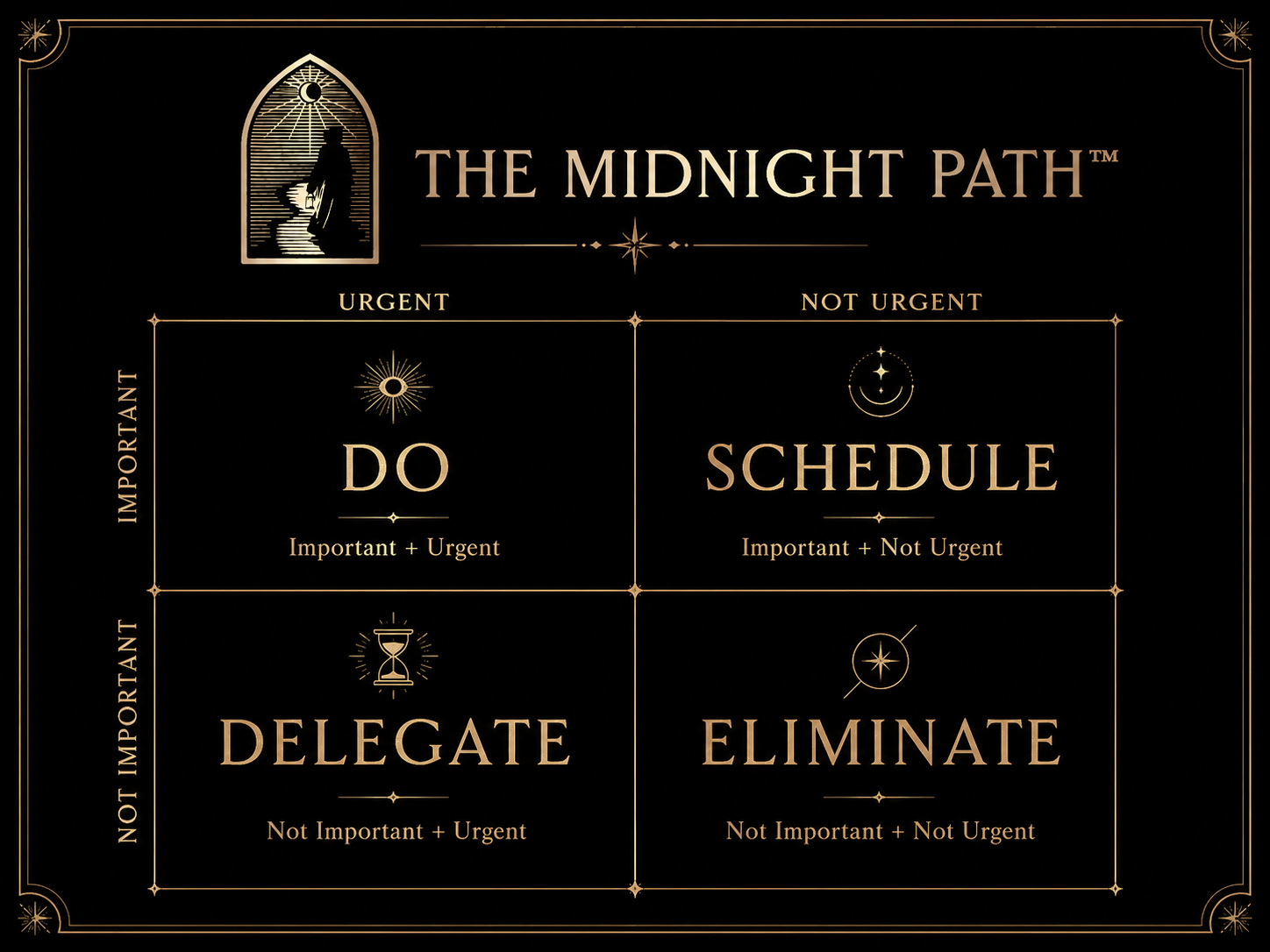
The matrix is useful for small decisions. The deeper insight is the original Eisenhower observation. The things that matter most rarely arrive with urgency attached. The book you should write, the relationship that needs your attention, the work that is yours, none of it has a deadline imposed by the world. The world’s urgency is almost entirely the world’s, not yours.
The opportunities that show up with urgency, the ones that need your answer by Friday or claim that if you do not commit now they will move on, are usually the patron’s urgency, not your important. They feel weighty because they feel pressing.
The discipline often comes down to this single distinction. Is this important to me, or is it just urgent to someone else?
Yet, the hardest refusals are not the ones you make to other people. They are the ones you make to yourself.
Saying No to Yourself
This is the deeper work.
Most of the writing on refusal focuses on saying no to others. Often the harder discipline is saying no to yourself.
Fasting traditions have always understood this. Lent and Ramadan are not really about some magic behind the fast. They are about the empowerment of self-denial as a practice of self-control. The absence of food alone does not make you holy. What it does is train the faculty of refusal itself, and once that faculty is trained, you can apply it to anything.
You can say no to the impulse to check your phone. To the second glass of wine. To the urge to respond to a comment that does not deserve it. To the project that would make you visible at the cost of the project that would make you whole.
The same principle runs underneath teachings about demonic possession. You cannot be possessed by anything you have authority to refuse. The will, in alignment with whatever higher principle you orient toward, is the only real protection. Like the vampire, you have to “let it in.”
Being In It Without Being Of It
Jesus said it best: “In the world, but not of it” (John 17).
You do not have to leave the world. I am not a Luddite. I use the internet for work. I have a phone, an Apple Watch, a screen open in front of me right now. I live just outside Amish country in Ohio and I see Amish people on cell phones at the gas station. The all-or-nothing version misses the point. The work is not about location or equipment, but rather, who has authority over your attention.
I have notifications off and focus mode set to let only my husband, my two sons, and a few close friends through. Everyone else waits. The focus app is the daily exercise of letting my yes be yes and my no be no. The people who get my attention have earned it.
The brand on the shirt is the same exchange. Why would I wear a logo on my body that I paid the company to put there? They should be paying me to advertise for them. The contemplative traditions taught this shift two thousand years before anyone called it consumer culture. The patron is always trying to extract from you. Refusal is what keeps the interior yours.
What happens if you actually refuse?
The Surprise of the Practice
The opportunities you turn down were almost always not meant for you. The ones meant for you arrive after, with room to receive them, because you held the cup empty.
This is not law of attraction or magical thinking or the secret. A person operating from scarcity grabs everything within reach. A person operating from abundance can afford to wait. Scarcity makes you smaller. Abundance makes you available.
The Stoics had a phrase for this. Amor fati. The love of one’s fate. The acceptance that what arrives is the right thing because you are oriented to receive it rightly. You cannot love your fate if you are constantly grasping at fates that were not yours.
So what do you actually do this week to start?
The smallest version of the practice still works. Once a week, sit down with whatever has arrived in front of you. Opportunities, requests, invitations, demands. Ask three questions.
Is this important to me, or just urgent to someone else?
If I say yes to this, what am I saying no to?
Will this fill my cup or empty it?
These questions bring your prohairesis online before the world’s pressure does it for you. Most of the refusals become obvious once you ask honestly.
Then practice the small no daily. Turn down one thing each day that you would normally have accepted out of habit, whether it is a notification, a task that was not actually yours, or a conversation that did not deserve your energy.
Hygieia at the offering dish decided what the serpent received. You are doing the same thing every time you say yes or no to what is in front of you.
After a month, you will notice what the older traditions noticed. The cup stays fuller. The opportunities that arrive feel more like yours. The ones you turn down stop feeling like loss.
Just say no, as the discipline that lets you be a self in a world built to extract selves into the patron’s purposes. It is older than the platforms trying to defeat it, and it will still be here when they are gone.
I will see you on the path. 🕯️
—Heather
Stepping into a new day. Not “love and light.” Not “doom and gloom.” Just Tradition.
Further reading: Epictetus, The Discourses and Enchiridion, the Robin Hard translation from Oxford. The Sayings of the Desert Fathers, Benedict Ward’s Cistercian Publications edition. Lao Tzu, Tao Te Ching, the Stephen Mitchell or Ursula K. Le Guin translation. Pierre Hadot’s Philosophy as a Way of Life remains the best introduction to the contemplative practices of late antiquity.
Dr. Heather Lynn is a historian and educator tracing the occult architecture beneath modern power. She is the creator and host of The Midnight Academy podcast and the author of five books, including Baphomet Revealed and Evil Archaeology. Her forthcoming book is Codex Machina: How AI Is Decoding Ancient Civilizations, Technologies, and Lost Languages in Our Search for Meaning. Find her at drheatherlynn.com.
Subscribe to The Midnight Academy: https://www.youtube.com/@DrHeatherLynn
Reminds me of parts of Graeber's "Debt: the First 5,000 Years."
One thing colonial powers did to cement their power was to extend credit to the locals, allowing them to buy things they didn't need. When tribal elders tried to break their people free, one of the first things they did was to try to get young people to say 'no' to all those temptations and not go into debt.
Same as it ever was.
After reading your last article, it became clear to me that voting is a humiliation ritual. I haven’t done it for decades (save for Ron Paul’s presidential run just to make a small point) and the no is empowering.
I’ve known it was useless and designed to get us to buy in but was never fully clear about it until your article, so thank you!