


Content warning: This article discusses suicide, infanticide, and the deaths of children. If you are struggling with suicidal thoughts or emotional distress in the United States, the 988 Suicide & Crisis Lifeline is available by calling or texting 988.
How can a woman kill her children? Is this yet another sign of the degeneracy of our society? Perhaps surprisingly (unsurprisingly for those who already subscribe to The H Files), mothers have been viciously killing their children for thousands of years. They killed newborns by drowning, smothering, strangling, throwing them into rivers, or sealing them in jars until they died. And those were the “humane” ways prescribed by early Roman law.
The unfortunate truth is that some mothers kill their children. We all know this is true. But what I want to address here is what happens in society when they do. It seems that whenever a mother kills a child, another institution appears almost immediately to explain what happened. That institution has been a temple, church, court, or hospital. No matter what, there is an authority waiting to try to determine if the mother was monster or victim, a murderer or madwoman. Someone must determine whether the dead child was murdered, sacrificed, or abandoned, so that the mother can be placed into some category the surrounding society can tolerate.
A mother killing her child is the single most paradigm-challenging concept humans face. Forget the confusion of “what is a woman.” Forget “birthing persons.” Forget the struggle to comprehend the difference between equality of outcome and equality of opportunity. The ultimate deconstructionist trick that would have made Derrida proud is to confuse the very first presupposition we have in utero: a mother’s love.
We expect the woman who created a baby to hold it tight to her breast and protect it at all costs, vicious as a mother animal in the wild, and when she betrays that life, she betrays our most primary and original comfort: the comfort of knowing the nature of reality itself.
Mothers killing their children is ancient and enduring. What changes, however, is the explanation as to why. Whoever controls the explanation possesses an extraordinary power over our core understanding of the nature of reality. This is not hyperbole.
Before Psychiatrists, They Were Priests
The Carthaginians, descendants of Phoenician settlers on the coast of North Africa, sacrificed their children to the gods, according to what their enemies wrote. Diodorus Siculus describes a horrifying scene during the Carthaginian crisis of 310 BCE involving children and a bronze image of Kronos, and Plutarch writes with similar revulsion. There are Biblical texts that condemn the passing of children through fire to Molech and the burning of sons and daughters at Topheth in the Valley of Hinnom. The Hebrew “Ge Hinnom,” the Valley of Hinnom, eventually gave us the word Gehenna. Gehenna became associated with burning and divine punishment and was later translated in English Bibles as “hell.” One of the words that helped construct the Western imagination of hell is attached to a place remembered for the burning of children, as I wrote about in this H File below.

At Carthage and other Punic sites, archaeologists have excavated areas called tophets and have found urns containing the cremated remains of young children along with some animals.

Why would human remains be interred with animals? Because every society that has embraced the death of infants made the decision as to when the life of a child became “fully human.”
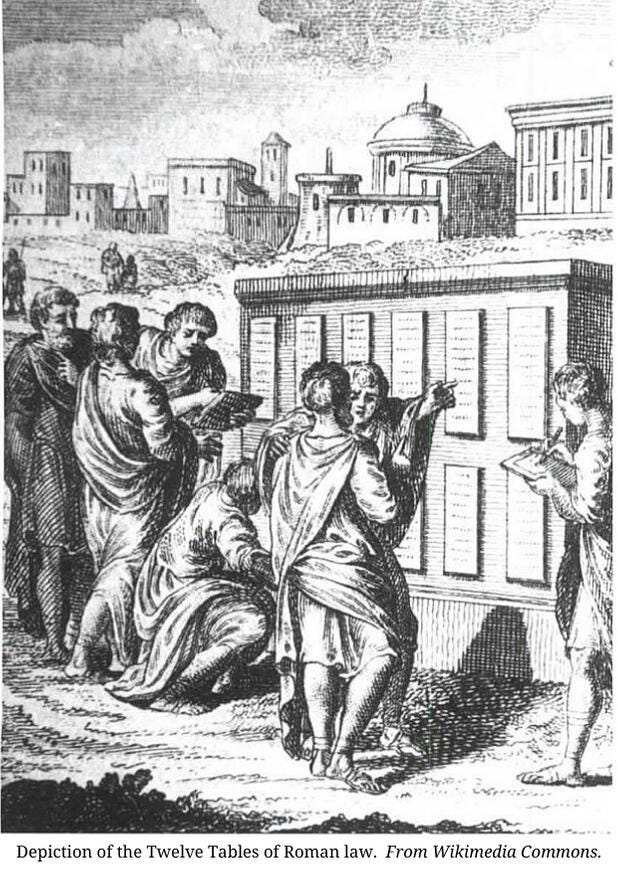
In the ancient Greek and Roman worlds, unwanted newborns were left to die from exposure. In some cases, the unwanted child may be rescued, sold, or enslaved. The Roman legal tradition granted enormous authority to the paterfamilias, the male head of household, and the Twelve Tables, Rome’s earliest written law code (c. 450 BCE), decreed that a severely deformed newborn should be killed. While Roman attitudes toward exposure, paternal authority, and infant killing changed over time, the larger pattern of infanticide can be found across cultures.
Christianity complicated that arrangement. Early Christian writers were unusually hostile to infant exposure and frequently treated abandonment as morally equivalent to killing, precisely because everyone understood what often happened to exposed children. Imperial law changed more slowly. Constantine restricted paternal power, criminalized paternal killing, and issued measures intended to prevent destitute parents from killing or exposing children by providing assistance. Later emperors continued altering the legal status of exposed children, and exposure itself persisted long after the empire became Christian. The change took time, but an important change in thinking had shifted the argument.
Then history found other ways to redraw the line. In medieval and early modern Europe, direct infanticide was condemned, but desperate women still became pregnant with children they could not support, could not acknowledge, or could not safely keep, and so institutions appeared. One was the foundling wheel: a small revolving door or barrel built into the wall of a convent, hospital or charitable institution, where a mother could place her infant, turn the mechanism, ring a bell and disappear without revealing her identity. It sounds humane, and compared with exposure in a ditch or the deliberate killing of an unwanted newborn, it was. But these institutions were often crowded with fragile infants, and disease, malnutrition, and overcrowding could produce catastrophic mortality. Nobody needed to decree that the child should die. The institution just had to accept the child, and the death could then become mortality rather than killing.
By Victorian England another market had appeared: baby farming. Women accepted unwanted infants for payment, usually with the promise that the child would be raised or placed in another home. Some undoubtedly did exactly that. Others discovered that a one-time payment became more profitable if the infant did not survive very long. Amelia Dyer, one of the most notorious examples, was eventually convicted of murder after operating for years in this shadow economy. Again the vocabulary mattered. A mother had not necessarily killed her baby; she had paid someone to take it. The institution standing between mother and death performed a kind of moral laundering.
The anthropologist Nancy Scheper-Hughes documented another version of this phenomenon in twentieth-century northeast Brazil. Under conditions of extreme poverty and staggering infant mortality, she described mothers becoming emotionally detached from infants perceived as unlikely to survive, while clinics sometimes supplied medications that quieted starving or dying babies. Scheper-Hughes was careful not to reduce these women to cruelty; the behavior existed within brutal economic conditions where families were making impossible calculations about survival. That distinction matters, but so does the pattern. Across radically different cultures, an intermediary appears between an intolerable reality and the language used to describe it. Temple, household, convent, foundling hospital, clinic: the cosmology changes, and the administrative function does not. There is always someone empowered to tell the community what category the child belongs in, what happened to it, and why the rest of us should understand the event in one way rather than another.
Which brings us to one of the most recognizable patterns in history, the moment the priest became the scientist.
