

The Vindex
The destroyer the Plan is waiting for, 250 active FBI cases, and the name Peter Thiel saw at Stanford.


A note on what follows. This piece describes the recruitment mechanics of a transnational network currently under active federal investigation in the United States, Canada, the United Kingdom, and continental Europe. The subject matter includes child exploitation, incitement to self-harm, and the doctrinal lineage that produced these cases. Every claim is sourced to the published scholarly and law-enforcement record. Discretion is advised. Readers personally affected by any of this should pace themselves through the piece. Public-safety resources are listed in the endnote.
The recruitment happens on the platforms parents associate with safety for their children: Roblox, Minecraft, gaming forums. The hashtag pools on Instagram where adolescents with eating disorders and self-harm find each other, and find, also, the people hunting them. Contact begins as sympathetic friendship inside a child’s existing online community. Trust develops over weeks. A first explicit image is requested. Once the image exists, the lever exists. The next demand follows.
There is a name for the marker the abusers instruct their child victims to leave on their own bodies. The marker is called the cut sign. Children are told to carve the abuser’s online name, the number 764, or a satanic sigil into their own skin, photograph the wound, and send the image back. The cut sign signals ownership. Once a child has produced one, the demands that follow have no floor. Animals are killed on camera. Suicide is encouraged on livestream. The footage circulates back through the channels that produced it, where it is called gore, and where it is used to groom and desensitize the next round of children entering the platform. The FBI documented the grooming pipeline in its September 2023 sextortion advisory; Shawn Boburg and Chris Dehghanpoor reconstructed the founding for the Washington Post in September 2024; and Tanya Mehra and Loes Hartgers compiled the cross-jurisdictional record in the 2025 ICCT policy brief Fury and Void.
The FBI opened its formal inquiry in 2023. By May of 2025 the Bureau confirmed roughly 250 active investigations of individuals affiliated with the group inside the United States alone. The Combating Terrorism Center at West Point has published its analysis of 764 and its affiliates. The Dutch National Coordinator for Counterterrorism and Security has named the category. The Royal Canadian Mounted Police has issued public warnings. The Belgian Coordination Unit for Threat Analysis has added members to its terrorism database. Federal courts in the United States have begun sentencing senior figures to terms measured in decades. Every Western intelligence service that pays attention to this material has now publicly named it a transnational threat (Mehra and Hartgers, ICCT 2025; NCTV Netherlands, June 2025; Europol Terrorism Situation and Trend Report 2025; RCMP advisory August 2024; ASIO December 2024).
The group is called 764. It was founded in 2020 by a sixteen-year-old from a small town in Texas named Bradley Cadenhead, who is currently serving an eighty-year sentence at the Allred Unit of the Texas Department of Criminal Justice. Cadenhead did not architect the doctrine 764 runs on. He absorbed it from the aesthetic and ideological residue of an older formation that had been working for forty years before he picked up a keyboard. The man who synthesized that older doctrine in the 1970s was a senior figure in the British neo-Nazi underground, writing from the Welsh Marches under a pseudonym. The figure his doctrine is preparing the way for has a specific name. The name is the Vindex.
This is the companion to Tuesday’s free piece on the Plan and the Golden Calf. Tuesday showed you the unifier the Plan is preparing the world to receive. Today shows you the destroyer the same Plan is preparing in parallel, in a different vocabulary, in a different carrier population, on the same calendar. These figures form the two faces of one choreography. The unifier needs a destroyer to arrive against. The destroyer needs the unifier as the target his arrival is supposed to vindicate. Both audiences are being trained to recognize their assigned figure at the same moment. The documents identify that moment as 2029 to 2032.
This piece walks through the historical name the destroyer doctrine chose for its awaited figure and what that name has carried in Western political theology for two thousand years, the lineage that produced 764 from its origins in postwar esoteric Hitlerism, the record of what the group has actually done to children whose names are now in court documents, and the parallel philosophical current that has produced the same theological structure inside the contemporary technology industry. The endnote at the bottom names the public-safety resources for parents who recognize the signs in someone they know.
What follows takes the history first, then walks into what this is producing on the federal docket right now.
The Roman Vindex
In March of the year 68, Gaius Julius Vindex, the Roman senator serving as imperial legate of the province of Gallia Lugdunensis, called together an assembly of Gallic magnates and raised the standard of revolt against the emperor Nero. He was a man of royal Aquitanian descent and an ex-praetor, a senior figure in the Roman administrative aristocracy. He claimed, at the outset, to have one hundred thousand men under arms (Brunt 1959, 531–533, drawing on Cassius Dio LXIII.22 and Plutarch, Galba 4–5).
The numbers were inflated. Everything else about the political moment was deadly serious. Nero’s emulation of Alexander the Great, his theatrical performances, his execution of senators and aristocrats, his murder of his mother, his looting of the provinces to fund his extravagance, had alienated the senatorial class and a significant portion of the provincial administration. Vindex had sounded out the other governors before he moved. Most of them sent word of his treason back to Nero. Only Galba, the governor of Hispania Tarraconensis, joined him (Brunt 1959, 532, citing Suetonius, Galba 9–10).
Vindex marched on the Rhone valley. The Rhine legions, under Verginius Rufus, marched to meet him. The two armies confronted each other near Vesontio, modern Besançon, in late May. Whether Verginius and Vindex conferred before the battle, as Cassius Dio reports, or whether the battle was fought without the Roman commanders fully intending it, as some moderns have argued, the result was the same. The Gallic forces were annihilated. Vindex took his own life on the field (Brunt 1959, 537, drawing on Tacitus, Histories I.51, Dio LXIII.24, and Plutarch, Galba 6).
The revolt failed militarily. The cascade it triggered ended the Julio-Claudian dynasty within weeks. Galba marched from Spain. The Praetorian Guard turned on Nero. The Senate declared him a public enemy. Nero killed himself on the ninth of June. The Year of the Four Emperors followed, ending only when Vespasian consolidated power in 69. The man who set the cascade in motion was already two months dead by then. The historian’s verdict, as Pliny the Elder put it in his Natural History, was that Vindex was adsertor ille a Nerone libertatis, “that liberator of liberty from Nero” (XX.160, cited in Brunt 1959, 539).
The Oxford classicist P. A. Brunt, in the foundational 1959 article on the revolt, summarized the political content this way: “Vindex rose to end oppression, not only of the senatorial class to which he belonged but of all Rome’s subjects. Like the Gordians in 238, he perished, but his cause triumphed, for he had not risen against Rome, but against Nero” (Brunt 1959, 531). The revolt was corrective in intent. He removed the corruption that had captured the order while leaving the order itself standing.
That distinction is the entire load the word has been carrying for two thousand years.
The Latin noun vindex derives from vim dicere, “to declare force” or “to assert by force.” It means avenger, claimant, protector, champion. In Roman law specifically, a vindex was a third party who intervened in legal proceedings on behalf of a defendant, standing surety against the arbitrary use of force by the accuser. The legal vindex broke a chain of unilateral coercion by inserting legitimate counter-force into the proceeding. The word, in its origin, names justified violence on behalf of the wronged.
Seneca, writing two years before the revolt, distinguished Hercules from Alexander on exactly these terms. Hercules was, in Seneca’s words, malorum hostis, bonorum vindex, terrarum marisque pacator, the enemy of evils, the avenger of the good, the peacemaker of land and sea. Alexander, by contrast, was a pueritia latro gentiumque vastator, a bandit from boyhood, a destroyer of nations. The figure of Hercules appears on coins Vindex authorized during his revolt. The propaganda was explicit. The man marching against Nero understood himself, and was understood by his historians, as occupying the structural slot Seneca had defined for Hercules (Brunt 1959, 547, citing Seneca, De Beneficiis I.13).
The word kept this load through the medieval and early modern periods. The Christian apocalyptic tradition picked it up in the form vindex sanguinis, the avenger of blood, applied to the returning Christ in patristic and medieval commentary on Revelation. The single most important text in the political-theological afterlife of the word is Vindiciae contra tyrannos, “Defenses against tyrants,” published in 1579 under the pseudonym Stephanus Junius Brutus the Celt. The author was almost certainly the Huguenot theorist Philippe Duplessis-Mornay, writing in the aftermath of the St. Bartholomew’s Day Massacre of 1572. The Vindiciae is one of the founding texts of the Protestant resistance tradition. It argues that subjects have a religious duty to resist tyrants who violate divine law, and that this duty falls in the first instance on the lesser magistrates, the vindices whose intervention against unlawful sovereign power is itself an act of fidelity to the higher law. That doctrine moves through European political thought into the American revolutionary tradition. The right of legitimate resistance to tyranny that runs through the Declaration of Independence has the vindex tradition in its bloodstream.
By the time the militant tradition I am about to describe takes hold of the word in the early 1980s, it has been carrying this load for two thousand years. The avenger who legitimately destroys. The champion whose violence is justified because the order he attacks has forfeited its right to exist, and whose action vindicates the moral law against the tyrant who has violated it.
Nothing about this word is innocent. The operators chose it for the reason they choose all of their vocabulary. The word does the recruiting work because the word is already loaded.
One thing to notice before we move on. The historical Vindex lost his battle. The Rhine legions cut his Gallic cavalry to pieces and he ended his own life on the field at Vesontio. The cascade that brought Nero down ran on without him. The militant operators in the 1980s, when they chose his name for their awaited destroyer, were naming the figure after a man who died failing. The name they chose belonged to a senator whose action vindicated a moral claim that outlasted his own death by two thousand years. The doctrine is consistent on this point. The literature on 764 and on M.K.Y. documents that participants do not expect long lives. The figures producing the harm on the federal docket are following the prototype’s pattern, acting in expectation that what they help start will run on without them.
Theosophy, Esoteric Hitlerism, and the Order of Nine Angles

A word on Theosophy for readers new to the term. Theosophy is the synthesis system Helena Petrovna Blavatsky and Henry Steel Olcott founded in New York in 1875. The word comes from the Greek theosophia, meaning wisdom about the gods or divine wisdom. Blavatsky’s claim was that the world’s religious traditions were surface expressions of a single underlying esoteric source, and that this source could be reconstructed by a scholar willing to do the comparative work. Her two major books, Isis Unveiled (1877) and The Secret Doctrine (1888), are the foundational texts. The Theosophical Society she co-founded still exists, and its institutional descendants include Lucis Trust, the Anthroposophical Society of Rudolf Steiner, the Krishnamurti Foundation, and dozens of other organizations whose vocabulary the contemporary New Age movement still draws on. From outside the academic study of religion, Theosophy looks fringe. Within that field, it is the foundation much of the late nineteenth and twentieth centuries’ alternative spirituality was built on.
The militant Vindex doctrine begins inside this Theosophical synthesis. Lucis Trust, founded in 1922 by Alice and Foster Bailey as the Lucifer Publishing Company, is one channel of that descent. The destroyer tradition is another. Both run on the same metaphysical chassis.
The chassis is the doctrine of aeons. Blavatsky’s cosmology holds that history runs through great cycles, each governed by a presiding force, each ending in a transition that is simultaneously destructive and revelatory. The Kali Yuga, the iron age of Hindu cosmology, is the active Aeon now, and it is ending. What comes after is a New Aeon, prepared by initiates and announced by a figure variously named in the religion one might be reading from. The Theosophical synthesis was explicitly syncretic. The figure was the Maitreya in Buddhism, the Kalki Avatar in Hinduism, the Christ in Christianity, the Imam Mahdi in Islam, the Mashiach in Judaism. He was the same figure, the operators taught, recognized differently by different prepared audiences.
The initiate, in this teaching, does not stand passively outside the Aeon’s transition. The initiate is its instrument. The doctrine holds that a ritual performed by a trained initiate at the correct cosmological moment can affect the larger cycle. The destruction of the current order is constitutive of the next one.
Every figure I am about to walk through inherits that outlook. They diverge on what to do with it. The Lucis Trust line, descending through Bailey into the universalist humanitarian framing that World Goodwill presents at the United Nations, teaches its students to participate ritually in the transition by reciting the Great Invocation, harmonizing with the Plan, and recognizing the Coming One when he arrives. The destroyer tradition teaches its students to participate ritually by accelerating the destruction of the current Aeon. The acceleration runs sometimes through ceremonial work called aeonic magic, sometimes through what Myatt’s ONA texts call practical means: terrorism and infiltration. The texts use the word “culling” for what the ONA literature defines as human sacrifice.
Savitri Devi and the Kalki Avatar
Maximiani Portas, the French-Greek woman who took the name Savitri Devi in 1928, was a Theosophist before she was a National Socialist. She read Blavatsky in her teens, including the doctrine of root races that held the current cycle to be the fifth, the Aryan, succeeded by a sixth race the Coming One would inaugurate. She went to India in 1932 to study Hindu philosophy and married a Bengali Brahmin who shared her interest in synthesizing European racial theory with Hindu cosmology. She spent the war years in India, supporting the Axis powers from Calcutta. She produced her major work, The Lightning and the Sun, in 1958, three years after she returned to Europe.
The Lightning and the Sun fused the Theosophical aeonic doctrine with what Devi herself called esoteric Hitlerism. The argument, in its essentials: history runs through three types of figures at the turning points of Aeons: the men against time, who try to reverse the decay of the current age and restore the previous one; the men in time, who flow with their own age and use it; and the men above time, who participate in the cyclical structure and embody the threshold itself. Hitler, in Devi’s reading, was the man against time who failed but who prepared the way. The figure who would succeed was the Kalki Avatar, the tenth avatar of Vishnu in Hindu eschatology, the rider on a white horse who arrives at the end of the Kali Yuga to destroy the corrupted order and inaugurate the next Aeon.
Devi was explicit about the structural identification. Kalki, in her synthesis, is the Hindu cosmological name for what Christians call the returning Christ, what Buddhists call the Maitreya, and what the Theosophists call the Coming One. The difference is that Devi was writing about the destroyer face of the figure. The avatar who comes with a sword. The avenger who closes the Aeon.
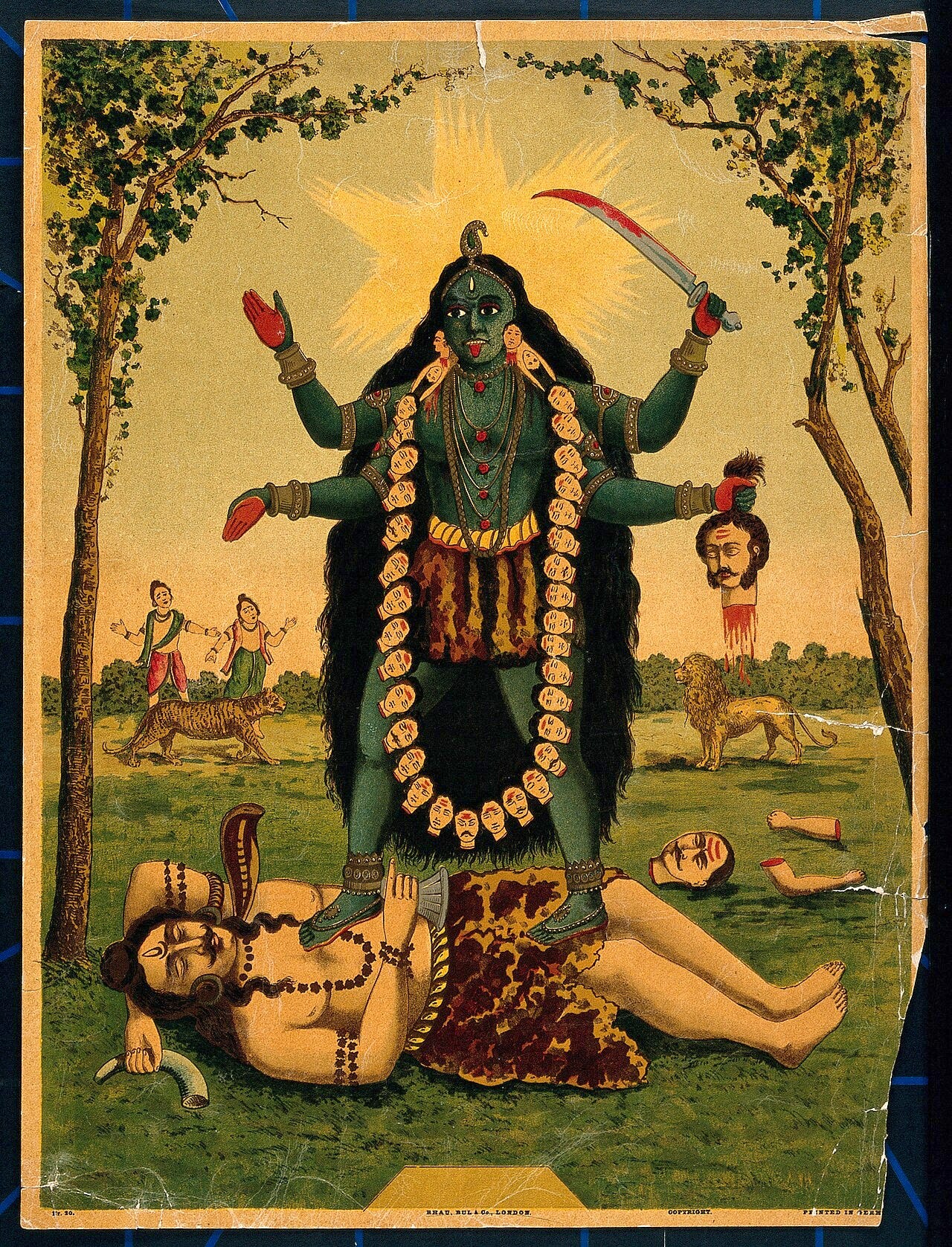
The standard scholarly treatment of Devi is Nicholas Goodrick-Clarke’s Hitler’s Priestess: Savitri Devi, the Hindu-Aryan Myth, and Neo-Nazism (NYU Press, 1998), which documents her influence on the post-war European far right with the scholarly remove appropriate to the material.
The Black Sun and the Last Avatar
The Chilean diplomat Miguel Serrano was one of the figures Devi influenced most directly. Serrano served as Chilean ambassador to India in the 1950s and 1960s, then to Yugoslavia and Austria. In the 1950s he met both Carl Jung and Hermann Hesse, and corresponded extensively with each. His political theology, developed across his trilogy El Cordón Dorado: Hitlerismo Esotérico (1978), Adolf Hitler, El Último Avatar (1984), and Manú: Por el Hombre que Vendrá (1991), is the most elaborated version of esoteric Hitlerism produced in the second half of the twentieth century.
Serrano’s contribution was to elaborate the Black Sun mythology that ran through Himmler’s SS occult program and fuse it with the Last Avatar doctrine. The Last Avatar, in Serrano’s reading, is the figure who arrives at the close of the Kali Yuga to destroy the current order and inaugurate what Serrano calls the Hyperborean New Aeon. Hitler is read as the prefiguring figure. The Last Avatar himself is awaited.
Serrano matters here for two reasons. His trilogy is the doctrinal source the Order of Nine Angles would later inherit, and he opened the bridge from European esoteric Hitlerism into the South American and global radical right networks of the late twentieth century. Goodrick-Clarke’s Black Sun: Aryan Cults, Esoteric Nazism, and the Politics of Identity (NYU Press, 2002) devotes its sixth chapter to him.
A note on actually reading this material. Devi’s Lightning and the Sun and Serrano’s trilogy are not easy to find in good editions. Devi’s book is mostly available through reprints by far-right publishing houses, which is its own warning sign. Serrano’s trilogy was published in Spanish in Chile in the 1970s and 1980s and has never had a full English translation from a mainstream press. The scholarly engagement with both is mostly through Goodrick-Clarke at NYU. What I can tell you, having spent significant time with both, is that the work is theologically literate and philologically careful. The arguments inside are structurally coherent. That is part of what makes them dangerous. The reader who encounters this material without the scholarly literature around it is at risk of taking it at the level it presents itself.
The synthesis happens with David Myatt. Myatt is one of the best-documented figures of the late-twentieth-century British radical right. In the 1970s he served as a bodyguard for Colin Jordan of the British Movement. He was a founding member of Combat 18, an organization whose name encodes the initials of Adolf Hitler (A and H being the first and eighth letters of the alphabet). In the 1990s he founded the National Socialist Movement. He converted to radical Islam in the early 2000s, producing essays on suicide bombing that appeared on the Hamas website, before reverting in 2010 to what he now calls a private philosophical path.

The 1998 Searchlight magazine investigation identified Myatt as the person behind the pseudonym Anton Long. Anton Long, since the early 1970s, had been the public voice of an organization called the Order of Nine Angles, which had emerged in the Welsh Marches region of Britain through the fusion of three earlier satanist and neo-pagan groups: Camlad, the Noctulians, and the Temple of the Sun. Myatt has consistently denied that he is Anton Long. The Sherbrooke University scholar Mathieu Colin, in a 2024 article in Terrorism and Political Violence, summarizes the academic consensus this way: “The origins of ONA are obscure, and the group is deeply linked to Anton Long, the suspected pseudonym of supremacist David Myatt, the Order of Nine Angle’s grandmaster (although Myatt has always denied any affiliation with it)” (Colin 2025, 688).
The Order of Nine Angles is the synthesis. It absorbs Devi’s aeonic Hitlerism, Serrano’s Last Avatar doctrine, and the ritual practice of Kenneth Grant’s Typhonian Order, which had been working the qliphothic side of the Kabbalistic Tree of Life since the mid-1950s. The doctrine is laid out across the texts produced under the Anton Long name from the late 1970s through the 1990s, including Codex Saerus: The Black Book of Satan, Naos, Hostia, and the four-volume Deofel Quartet. Colin’s article documents the system in detail. So does Jacob Senholt’s 2009 doctoral work at Aarhus University, and the standard treatment by Goodrick-Clarke in chapter ten of Black Sun.
The text in the ONA corpus that names the destroyer figure is titled Vindex: Destiny of the West. It was issued under the Anton Long name in 1984. The figure it describes is the avenger who arrives at the close of the current Aeon to destroy what Myatt’s texts call the Nazarene values, the dominance of the Magian-Hebraic civilization, and to inaugurate the Galactic Imperium of the Homo Galacticus, the race of supermen who will succeed the current human form.
Here is Colin’s summary of the doctrine. It’s the cleanest scholarly statement of it I have seen:
“Adolf Hitler and the Third Reich are thus considered, by several of Myatt’s texts, as the manifestation of the ‘Satanic spirit’ as nexions supposed to herald the coming of Vindex, a vengeful entity, and the ‘Galactic Imperium’ in which the race of supermen will finally be able to dominate after the annihilation of ‘Nazarene’ values, those of the Jews, which dominate our current civilization” (Colin 2025, 691, citing Goodrick-Clarke 2002, 221).
The Vindex, in the working doctrine, is the figure who arrives to destroy what the ONA texts call the dominance of Magian values. The Nazi state, in the doctrine, was the first nexion, the failed prefiguration. The figure himself is still awaited. The work of the order is to prepare his arrival. The methods include what the ONA texts call aeonic magic, the ritual participation in the Aeon’s transition. They include what the texts describe as “Insight Roles”: six-to-eighteen-month field assignments in which initiates infiltrate jihadist groups, far-right movements, the police, and the military, to gain experience and to radicalize those institutions. The texts also name a practice called culling, which the ONA literature defines as human sacrifice, either ritualized or carried out as assassination through manipulation. (Colin 2025, 690–692; ONA, Definitive Guide to the Order of Nine Angles, 2015, pp. 394, 415–416, 442, 448).
This is not exoteric weirdness. The ONA’s Definitive Guide to the Order of Nine Angles, published in 2015 and freely available on the Internet Archive, runs to roughly fifteen hundred pages. The doctrine is fully articulated and the methods explicit. The audience knows what it is reading. The scholarly literature on the order, including Senholt, Colin, Goodrick-Clarke, Connell Monette, Jeffrey Kaplan, Mattias Gardell, Ariel Koch, and the more recent terrorism-studies treatments by Gartenstein-Ross and Chace-Donahue, converges on the same theme: a complete esoteric and political system whose stated aim is the destruction of the current civilizational order in preparation for the arrival of the Vindex.
Tempel ov Blood and the Path to 764
Now to what forty years of this doctrine looks like when it lands in a federal courtroom.
The line from the ONA to the current American criminal ecosystem runs through a single nexion called Tempel ov Blood. The Tempel ov Blood was an American O9A-derived group founded in the late 1990s, working primarily through correspondence and a publishing imprint called Martinet Press, with significant activity inside American prison systems. Its central figure, Joshua Caleb Sutter, was the son of a prominent Christian Identity pastor. Sutter became an informant for the FBI in 2003, a fact that emerged only in 2020 through reporting by Robert Evans and Jason Wilson in The Guardian, and continued working inside the network as a confidential source for approximately seventeen years while simultaneously producing some of the most serious accelerationist literature of the period.
Tempel ov Blood was the fusion of ONA teachings with the explicit white-power organizing of the post-Christian Identity milieu and with the industrial-music and prison-recruitment subcultures that gave the texts their American carrier population. The accelerationism research consortium’s standard treatment of the Skull Mask network, published by Kriner and colleagues at GNET in 2024, documents the takeover of Atomwaffen Division by Tempel ov Blood members in 2017. James Cameron Denton, the Siege-inspired leader who took over Atomwaffen that year, brought Sutter and other Tempel ov Blood members into the organization. Martinet Press books became required reading for AWD recruits.
The aesthetic vocabulary you see across the contemporary accelerationist ecosystem, including the skull-mask imagery from James Mason’s Siege, the Sonnenrad, the runic typography, the horrorcore music, the dehumanizing visual treatments of victims, all of it was consolidated in the AWD-era fusion of ONA material with the post-Iron March forum culture between 2017 and 2020. The 2019 federal indictments of AWD members and the subsequent arrests of the group’s leadership produced a power vacuum in which the residual influence of the ONA continued to propagate across what counter-extremism researchers now call Terrorgram, the Telegram-based accelerationist ecosystem.
The 764 network emerges in 2020 directly out of this milieu. Cadenhead was sixteen years old when he founded the group. He had no formal initiation into the ONA. By all available evidence he was a damaged child who absorbed the aesthetic and ideological residue of the AWD-era ecosystem and constructed a network whose practice was the production and distribution of gore, child sexual abuse material, and incitement to suicide and self-harm. The Anti-Defamation League’s 2025 backgrounder on 764 documents the symbolism explicitly. The 764 logo contains the pentagram, the satanic cross, and a stylized Baphomet figure. The aesthetic is the AWD aesthetic, simplified for younger recruits and stripped of the explicit white-nationalist political content.
The Maniac Murder Cult, the Russia- and Ukraine-based network typically abbreviated as M.K.Y. or M.K.U., is the parallel formation working across the post-Soviet space, the United States, and Europe. The Combating Terrorism Center at West Point published its analysis of M.K.Y. in September of 2024, written by Marc-André Argentino, Barrett Gay, and Matt Bastin. The analysis names M.K.Y. as a racially and ethnically motivated violent extremist (REMVE) group with a militant accelerationist ideology rooted in Theistic Satanism and the ONA tradition. The group’s founder, Mikhail Chkhikvishvili, was extradited from Moldova to the United States in May 2025 to face federal charges including a plot to poison Jewish children with drug-laced candy while disguised as Santa Claus. He is now in federal custody in the Eastern District of New York.
The Tempel ov Blood, AWD, 764, and M.K.Y. ecosystem, taken together, is what the federal docket is processing. The doctrine is the ONA’s Vindex doctrine, downstream through forty years, simplified and aestheticized for a new generation, put into practice across the online platforms that generation grew up inside. Some of the figures who founded each of these networks had formal training in the texts. Most absorbed the imagery, the music, and the basic worldview from the older formation without ever reading the source texts.
The Mehra and Hartgers policy brief published by the International Centre for Counter-Terrorism in The Hague in 2025 is currently the cleanest single-document summary of what the prosecutions look like across jurisdictions. The May 2024 Department of Justice press release announcing the arrest of “Leaders of 764” out of the District of Columbia identifies the network as a global child exploitation enterprise. The case data is public and the texts have been documented in the scholarly literature for forty years. Almost no one has been willing to say in print that the two describe the same phenomenon.
I will say it. The figures producing the harm on the federal docket are downstream of a doctrine they did not invent. The doctrine is structurally identical to the one I described in Tuesday’s piece, inverted at the figure who arrives at the close of the Aeon. Without the doctrinal map, the federal cases look like discrete pathologies. With the doctrinal map, they look like what they are.
What comes after this is the inside view: the vocabulary the network uses for itself, the specific federal cases that have produced convictions, the connection between this network and recent mass shootings the mainstream press did not address, the anomaly at the founder level that has not been processed in print, and the pattern of what has happened to citizen researchers and counterterrorism analysts who have tried to surface this material publicly. The remainder is for paid subscribers.
What the Network Actually Does, and What Happens to People Who Document It
The network’s self-understanding is visible in its internal vocabulary, which the federal cases and the academic literature have begun to document in detail. A “hell room” is a 764 Telegram channel where the produced content is shared. An
